
Admin

housing and groceries

Canada implements policies to make housing and groceries more affordable

Canada implements policies to make housing and groceries more affordable. A recent Leger poll revealed that 83% of 1522 newcomers in Canada are struggling with the rising cost of living. Similarly, Statistics Canada found that over a third of newcomers spend more than a third of their pre-tax income on rent. To address this, the federal government announced new affordability measures.  First, the Deputy Prime Minister announced a $99 million national increase to the Canada Housing Benefit, which helps to make rent more affordable by sending rent support payments directly to Canadians. This increase brings the federal government’s contribution to the Canada Housing Benefit to $325 million in 2023-24, which will go directly to low-income renters via provincial and territorial rent support programs. By 2027-28, the Canada Housing Benefit will have contributed to making rent more affordable for over 300,000 low-income households. Other measures include the $4 billion Housing Accelerator Fund to boost housing production, the Canadian Mortgage Charter for mortgage relief, and the Tax-Free Home Savings Account, allowing first-time buyers to save CAD 40,000 tax-free for a downpayment.  To help make groceries and other essentials more affordable, the Honourable François-Philippe Champagne, Minister of Innovation, Science, and Industry, has tripled federal funding for Canada’s Contributions Program for Non-profit Consumer and Voluntary Organizations to $5 million annually. Minister Champagne announced new projects in collaboration with consumer advocacy groups to investigate and expose price inflation and harmful business practices, such as shrinkflation and skimpflation in the grocery industry, as well as other forms of corporate greed that have put Canadians’ prices for everyday goods. Join our RSS Feed    If you want to know more details about “Canada implements policies to make housing and groceries more affordable” you can contact one of our immigration specialists at  Gunness & Associates.   Tel: (416) 604-2669  Email: info@test.immigrationmatters.info Gunness & Associates has helped thousands of people successfully immigrate to Canada with their families. Our skilled and experienced immigration experts have the expertise to accurately examine your case and advise you on the best method of proceeding to serve your needs.   For honest and straightforward advice, contact the experts at Gunness & Associates Get a free Assessment  Join our newsletter and get up-to-date immigration news Click here All rights reserved ©2023 Gunness & Associates

Immigrant retention rates

Immigrant retention rates across Canadian provinces

Statistics Canada’s 2022 Longitudinal Immigration Database reveals trends in immigrant retention rates across Canada. Atlantic provinces (Nova Scotia, New Brunswick, Prince Edward Island, and Newfoundland and Labrador) saw rising retention rates, while the prairie provinces of Saskatchewan and Manitoba experienced declines.  Ontario, British Columbia, and Alberta displayed the highest five-year retention rates for newcomers who landed in 2016, exceeding 84%, with Ontario leading at 93.1%. Saskatchewan and Manitoba witnessed significant drops in retention rates for those landing between 2012-2016.  New Brunswick reached its highest five-year retention rate in the Atlantic provinces at 56%, and PEI reported an increase, though it still has the lowest retention rate at 30.9%.  Newfoundland and Labrador’s one-year retention rate rose from 55% in 2016 to 66.4% in 2020. While most newcomers settle in larger provinces due to established immigrant communities, rural regions may struggle to maintain a robust labor force. Retention rates of the PNP immigrants The results found that PNP immigrants tend to remain in the province or territory where they arrived. Overall, 89% of provincial nominees who landed in 2019 remained in their intended province or territory at the end of the landing year. However, there was a significant variation by province or territory, ranging from 69% to 97%. Of those nominees who were in a province at the end of the landing year, a large proportion (in the mid-80% range) remained there five years later. Again, there was significant variation by province, with results ranging from 39% to 94%.  Overall, long-term retention of provincial nominees was quite high in Ontario, Alberta, and British Columbia, especially when considering both inflows and outflows. Long-term retention rates in Manitoba, Saskatchewan, and Nova Scotia have been intermediate but still relatively high. Prince Edward Island, New Brunswick, and Newfoundland and Labrador had the lowest retention rates. The retention rates of family-sponsored immigrants and refugees The five-year provincial and territorial immigrant retention rates varied by admission category. Among immigrants admitted between 2012 and 2016, those sponsored by the family had the highest five-year retention rate, followed by refugees. For the 2016 admission cohort, 91.7% of family-sponsored immigrants and 86.4% of refugees filed taxes in their intended destination province or territory five years after admission. Skilled immigrants’ five-year retention rate dropped by 5.8 percentage points, from 83.5% in 2012 to 77.7% in 2016. Meanwhile, economic immigrants admitted through the PNP had a substantially lower five-year retention rate (-8.1 percentage points), passing from 79.6% for provincial and territorial nominees admitted in 2012 to 71.5% for their counterparts admitted in 2016. In contrast, economic immigrants admitted as caregivers or through the Canadian Experience Class (CEC) maintained high five-year retention rates across all observed admission cohorts. 94.9% of immigrants admitted as caregivers in 2016 continued to file taxes in their intended destination province or territory five years later, in contrast to 88.1% of CEC immigrants. Join our RSS Feed    If you want to know more details about “Canadian provinces where immigrants are moving and staying” you can contact one of our immigration specialists at  Gunness & Associates.   Tel: (416) 604-2669  Email: info@test.immigrationmatters.info Gunness & Associates has helped thousands of people successfully immigrate to Canada with their families. Our skilled and experienced immigration experts have the expertise to accurately examine your case and advise you on the best method of proceeding to serve your needs.   For honest and straightforward advice, contact the experts at Gunness & Associates Get a free Assessment  Join our newsletter and get up-to-date immigration news Click here All rights reserved ©2023 Gunness & Associates

agri-food occupations

Express Entry draw for agriculture and agri-food occupations

On February 16, 2024, Immigration, Refugees and Citizenship Canada (IRCC) held a new draw for agriculture and agri-food occupations. It issued 150 Invitations to Apply (ITA) to candidates working in Agriculture and agri-food occupations. This was the third Express Entry draw of the week.  In round #285, the cut-off score was 437, 51 points more than in the previous draw for this category. The tie-breaking rule for this round was January 29, 2024, at 03:32:58 UTC. As of February 11, 2024, there were 211,273 profiles registered in the Express Entry pool. This year, Canada issued 15,420 ITAs through Express Entry draws. Express Entry Category-based selection In May 2023, IRCC introduced invitation selection rounds based on category. The department established six new categories to address specific human capital attributes. One category is for candidates who can demonstrate proficiency in French. The remaining five categories are occupation-based, including: Healthcare occupations. Science, technology, engineering, and mathematics (STEM) careers. Carpenters, plumbers, and contractors are examples of trade occupations. Transport occupations. Agricultural and agri-food openings. To be considered for category-based selection, candidates must be eligible for an Express Entry program and have applied to one of the three programs. Join our RSS Feed    If you want to know more details about “Express Entry draw for agriculture and agri-food occupations” you can contact one of our immigration specialists at  Gunness & Associates.   Tel: (416) 604-2669  Email: info@test.immigrationmatters.info   Gunness & Associates has helped thousands of people successfully immigrate to Canada with their families. Our skilled and experienced immigration experts have the expertise to accurately examine your case and advise you on the best method of proceeding to serve your needs.   For honest and straightforward advice, contact the experts at Gunness & Associates Get a free Assessment  Join our newsletter and get up-to-date immigration news Click here All rights reserved ©2023 Gunness & Associates

safest Country to Travel in 2024

Canada is the safest Country to Travel in 2024

Canada is rated the safest country to travel in 2024, moving from sixth in 2023. It topped the safety rankings for transportation, absence of violent crime, health measures, and safety for women, LGBTQIA+, and BIPOC. The ranking is part of Berkshire Hathaway Travel Protection’s Safest Destinations report, which relies on surveys, the Global Peace Index, the State Department’s travel safety ratings, and GeoSure Global scores.  The company defined a safe place free from terrorism, disease outbreaks, discrimination, and harassment. They attributed Canada’s top rank to its cold weather and low population density but warned of natural disasters like wildfires and avalanches. Despite this, reviews were largely positive.  Safest Country to Travel in 2024 In an era where safety and security are paramount concerns for travelers worldwide, Canada has emerged as the premier choice for those seeking a secure and welcoming destination. According to Berkshire Hathaway Travel Protection’s latest Safest Destinations report, Canada has claimed the coveted title of the safest travel destination for 2024, marking a significant ascent from its sixth-place ranking in the previous year. To explore the world’s safest Country in 2024, You need to get a free legal assessment This accolade comes as no surprise to those familiar with Canada’s reputation for excellence in various aspects of safety. The country excelled across multiple criteria, including transportation safety, the absence of violent crime, stringent health measures, and a commitment to ensuring the safety and inclusion of all travelers, including women, LGBTQIA+ individuals, and BIPOC communities. The methodology behind this ranking involved a comprehensive assessment, drawing upon surveys, the Global Peace Index, the State Department’s travel safety ratings, and GeoSure Global scores. Berkshire Hathaway Travel Protection defined a safe destination as one that is free from threats such as terrorism, disease outbreaks, discrimination, and harassment. Canada’s rise to the top of the safety rankings can be attributed to several key factors. The nation’s cold weather and low population density were cited as contributing factors to its overall safety profile. Moreover, Canada’s robust infrastructure and proactive measures in ensuring the well-being of its residents and visitors have played a pivotal role in earning this accolade. Other nations featured prominently in the Safest Destinations report include Switzerland, ranked second, followed closely by Norway, Ireland, and the Netherlands. While these countries offer their unique charms and attractions, Canada’s unparalleled safety standards and inclusive atmosphere set it apart as the premier choice for travelers seeking peace of mind. As the world continues to navigate an ever-changing landscape of travel advisories and safety concerns, Canada stands as a beacon of stability and security. Whether exploring the vibrant streets of Toronto, immersing oneself in the breathtaking beauty of the Canadian Rockies, or experiencing the cultural richness of Montreal, travelers can embark on their journeys with confidence, knowing that they are in one of the safest destinations on Earth. Canada’s rise to the top of the Safest Destinations report reaffirms its status as a global leader in ensuring the safety and well-being of travelers. As we look ahead to a future of exploration and discovery, let Canada be your trusted companion on your next adventure, where safety is not just a priority but a way of life. Join our RSS Feed    If you want to know more details about “Canada is the safest Country to Travel in 2024″ you can contact one of our immigration specialists at  Gunness & Associates.   Tel: (416) 604-2669  Email: info@test.immigrationmatters.info   Gunness & Associates has helped thousands of people successfully immigrate to Canada with their families. Our skilled and experienced immigration experts have the expertise to accurately examine your case and advise you on the best method of proceeding to serve your needs.   For honest and straightforward advice, contact the experts at Gunness & Associates Get a free Assessment  Join our newsletter and get up-to-date immigration news Click here All rights reserved ©2023 Gunness & Associates

PEI PNP 3rd round of 2024

PEI issued 121 invitations under the PEI PNP 3rd round of 2024

On February 15, 2024, Prince Edward Island conducted a new invitation round and invited 121 candidates to the Prince Edward Island Provincial Nominee Program (PEI PNP). In the PEI PNP 3rd round of 2024, the province issued 121 invitations to apply to skilled workers in the Labour Impact and Express Entry streams.  PEI also invited one candidate to the Business Work Permit Entrepreneurs stream. The lowest score for business candidates was 105 points, 25 points more than in the January draw. This year, PEI invited 336 candidates. According to the schedule, the next PEI PNP draw will occur on February 29, 2024. The PEI EOI system collects critical information about you to rank and select those who are most likely to meet Prince Edward Island’s economic and labor market needs, based on one or more of the following characteristics: Languages: English or French. Education: level, field of study, and where completed; Skill and work experience levels; Strategic priorities are attributes that would address immediate labor market needs in PEI. Other factors that may impact employment prospects include but are not limited to, having a job offer in PEI and/or previous Canadian work experience. Prince Edward Island’s PNP Draw Schedule 2024 The most recent PEI PNP draw aligns with the recently announced PEI PNP draw schedule for 2024. PEI is the only Canadian province that releases its draw schedule in advance. To immigrate to Prince Edward Island, you must first create an Expression of Interest (EOI) profile. Your EOI profile includes personal information, education, work experience, language proficiency, and other information. When you submit your application, you will receive a score from the PEI PNP points calculator. The higher your score, the better your chances of being nominated. Join our RSS Feed    If you want to know more details about “PEI issued 122 invitations under the PEI PNP 3rd round of 2024″ you can contact one of our immigration specialists at  Gunness & Associates.   Tel: (416) 604-2669  Email: info@test.immigrationmatters.info   Gunness & Associates has helped thousands of people successfully immigrate to Canada with their families. Our skilled and experienced immigration experts have the expertise to accurately examine your case and advise you on the best method of proceeding to serve your needs.   For honest and straightforward advice, contact the experts at Gunness & Associates Get a free Assessment  Join our newsletter and get up-to-date immigration news Click here All rights reserved ©2023 Gunness & Associates

new Changes to the PGWP

IRCC implemented the new Changes to the PGWP

As of February 15, 2024, the Government of Canada implemented new Changes to the PGWP. From this date forward, students who have completed a master’s degree program, even under two years, can qualify for a 3-year PGWP, provided they meet all other eligibility criteria.  However, starting September 1, 2024, students enrolled in curriculum licensing agreement programs will no longer be eligible for a PGWP. In addition, the special measures for distance learning and PGWP validity have been extended until August 31, 2024. Details of the new Changes to the PGWP One of the most prominent modifications pertains to the duration of PGWPs for master’s degree graduates. Previously, the length of the permit was contingent on the duration of the study program, with a maximum allowance of three years. However, under the new guidelines, even students who have completed a master’s degree program spanning less than two years can now qualify for a 3-year PGWP, provided they fulfill all other eligibility requirements. This expansion opens doors for a broader spectrum of graduates, empowering them with extended opportunities to explore and secure employment in Canada post-graduation. For assistance, to study in Canada get a free assessment On the flip side, beginning September 1, 2024, students enrolled in curriculum licensing agreement programs will face a setback as they will no longer be eligible for a PGWP. This change underscores the importance of staying informed about evolving regulations and making strategic decisions regarding academic pursuits and career aspirations. Furthermore, in response to the evolving landscape of education amidst the global pandemic, the government has extended special measures for distance learning and PGWP validity until August 31, 2024. This extension acknowledges the ongoing challenges faced by students and institutions alike, ensuring continued support and flexibility in navigating the uncertainties brought about by the pandemic. The recent adjustments to the PGWP program by the Immigration, Refugees, and Citizenship Canada (IRCC) mark a significant milestone in facilitating pathways for international students to contribute to Canada’s workforce and economy. While these changes present new opportunities for some, it’s crucial for students and stakeholders to remain vigilant and adapt to the evolving regulatory landscape to make informed decisions about their academic and professional journeys. Stay updated, stay informed, and seize the opportunities that lie ahead. Canada has capped the international student intake for 2024-2025 On January 22, 2024, Canada’s Minister of Immigration, Refugees and Citizenship Canada (IRCC), Marc Miller, announced a two-year cap on international student permit applications to stabilize growth. For 2024, the cap will result in around 360,000 approved permits, a 35% decrease from 2023. These measures do not apply to master’s, doctoral, elementary, and secondary education students and current permit holders. Read More Join our RSS Feed    If you want to know more details about “IRCC implemented the new Changes to the PGWP” you can contact one of our immigration specialists at  Gunness & Associates.   Tel: (416) 604-2669  Email: info@test.immigrationmatters.info   Gunness & Associates has helped thousands of people successfully immigrate to Canada with their families. Our skilled and experienced immigration experts have the expertise to accurately examine your case and advise you on the best method of proceeding to serve your needs.   For honest and straightforward advice, contact the experts at Gunness & Associates Get a free Assessment  Join our newsletter and get up-to-date immigration news Click here All rights reserved ©2023 Gunness & Associates
6th BC PNP draw of 2024

In the 6th BC PNP draw of 2024 British Columbia issued up to 204 invitations

In the 6th BC PNP draw of 2024 British Columbia invited skilled candidates and tech professionals On February 13, 2024, the Government of British Columbia held new invitation draws under the British Columbia Provincial Nominee Program (BC PNP) and issued invitations to apply to qualified candidates in tech, healthcare, childcare, construction, and veterinary care occupations.  Details of the 6th BC PNP draw of 2024 Tech Draw: In the tech draw, the province invited 77 candidates. The minimum score for candidates invited to this draw was 108 points.  Childcare-targeted draw: BC issued 54 ITAs to candidates under the childcare-targeted draw for early childhood educators (NOC 42202).  Healthcare-targeted draw: British Columbia invited 41 candidates who scored 60 points in the Healthcare-targeted draw.  Construction sector invitations: The province also issued 27 invitations to candidates working in the construction sector.  Veterinary care invitations: up to five invitations have been issued to candidates working in veterinary care occupations.  British Columbia issued up to 204 ITAs in the sixth draw of 2024. This year, the province has already invited up to 1,426 candidates. British Columbia’s sixth draw of 2024 reaffirms its status as a welcoming destination for skilled immigrants across various sectors. By strategically targeting occupations and issuing many invitations, the province aims to address labor market needs and foster economic prosperity. As British Columbia remains committed to immigration, prospective candidates can look forward to further opportunities to contribute to the province’s vibrant communities and thriving economy. Targeted invitations to apply for Skills Immigration streams may be based on one or more of the following factors: Education – the level, field, and location where the education was completed. Eligible professional designations in British Columbia. Language skills. Occupation. The length and level of work experience. Salary and/or skill level of job offer. Intend to live, work, and settle in a specific area. Strategic priorities are factors that address specific labor market needs in British Columbia or provide support for government pilot projects and initiatives. Join our RSS Feed    If you want to know more details about “British Columbia issued up to 204 candidates in the 6th draw of 2024″ you can contact one of our immigration specialists at  Gunness & Associates.   Tel: (416) 604-2669  Email: info@test.immigrationmatters.info   Gunness & Associates has helped thousands of people successfully immigrate to Canada with their families. Our skilled and experienced immigration experts have the expertise to accurately examine your case and advise you on the best method of proceeding to serve your needs.   For honest and straightforward advice, contact the experts at Gunness & Associates Get a free Assessment  Join our newsletter and get up-to-date immigration news Click here All rights reserved ©2023 Gunness & Associates

The Express Entry categories

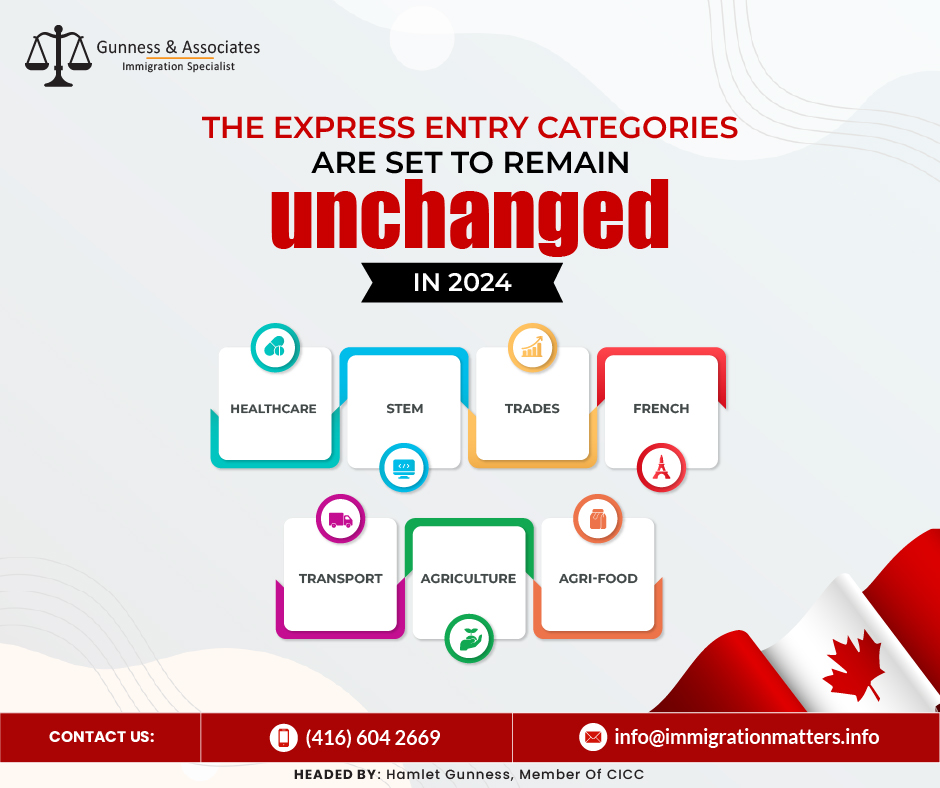
The Express Entry categories are set to remain unchanged in 2024

Canada will retain the Express Entry categories this year, according to Immigration, Refugees, and Citizenship Canada (IRCC). These include French, Healthcare, STEM, Trades, Transport, Agriculture, and agri-food categories, selected based on Canada’s economic needs and in consultation with stakeholders.  In 2023, there were 17 category-based draws across these sectors. Changes to the frequency of draws have been observed since the introduction of category-based selection in June 2023. The impact of these changes on Canadian immigration will become clearer once more data is available and more receive permanent residency in early 2024. In 2023, there were 17 category-based draws: French category: 6 draws Healthcare category – three draws STEM category – two draws. Trades category – two draws. Transport category – two draws Agriculture and agri-food category – two draws. Express Entry Category-based selection in 2023 On June 28, 2023, the first category-based selection draw was held, inviting 1,500 express-entry candidates to work in eligible healthcare occupations. Throughout the rest of the year, IRCC invited over 16,000 Express Entry candidates via category-based selection in 17 different draws. So far in 2024, there has been one category-based selection draw for 7,000 candidates with French language proficiency. About the Express Entry Express Entry is a system used by the Canadian government to manage applications for permanent residence from skilled workers. It is the primary pathway for immigrants who wish to settle in Canada based on their skills, work experience, language ability, and other factors. The Express Entry system operates through three main immigration programs: Federal Skilled Worker Program (FSWP): This program is for skilled workers with foreign work experience who want to immigrate to Canada permanently. Applicants must meet specific criteria related to education, work experience, language proficiency, and adaptability factors. Federal Skilled Trades Program (FSTP): This program is for skilled tradespeople who have at least two years of full-time work experience in a skilled trade within the five years preceding their application. They must also meet certain language and other requirements. Canadian Experience Class (CEC): This program is for individuals who have gained skilled work experience in Canada temporarily and wish to transition to permanent residency. Applicants must have at least one year of Canadian work experience in a skilled occupation and meet language and other criteria. Join our RSS Feed    If you want to know more details about “The Express Entry categories are set to remain unchanged in 2024″ you can contact one of our immigration specialists at  Gunness & Associates.   Tel: (416) 604-2669  Email: info@test.immigrationmatters.info   Gunness & Associates has helped thousands of people successfully immigrate to Canada with their families. Our skilled and experienced immigration experts have the expertise to accurately examine your case and advise you on the best method of proceeding to serve your needs.   For honest and straightforward advice, contact the experts at Gunness & Associates Get a free Assessment  Join our newsletter and get up-to-date immigration news Click here All rights reserved ©2023 Gunness & Associates

1st healthcare-targeted Express Entry draw

IRCC held the 1st healthcare-targeted Express Entry draw of 2024

On February 14, 2024, IRCC held the 1st healthcare-targeted Express Entry draw of 2024 and issued 3,500 Invitations to Apply (ITA) to candidates working in healthcare occupations.  In round #284, the cut-off score was 422 points, nine points fewer than in the previous healthcare-targeted Express Entry draw and the lowest ever since IRCC launched the category. The tie-breaking rule for this round was January 30, 2024, at 02:39:54 UTC. As of February 11, 2024, there were 211,273 profiles registered in the Express Entry pool. This year, Canada issued 15,270 ITAs in 6 Express Entry draws. Furthermore, 2024 witnessed a total issuance of 15,270 ITAs across six Express Entry draws, highlighting Canada’s commitment to welcoming skilled individuals from around the globe. This concerted effort aligns with the nation’s ongoing endeavor to address labor shortages and bolster its healthcare workforce, especially in light of global challenges such as the pandemic. To start your career in Canada as a Healthcare Specialist, You need to get legal assistance from Gunness & Associates Aspiring immigrants in the healthcare sector can view this latest Express Entry draw as a beacon of hope, offering promising pathways to realize their dreams of living and working in Canada. With a streamlined selection process and favorable cut-off scores, the Express Entry system continues to serve as a vital avenue for skilled professionals seeking to contribute to Canada’s vibrant healthcare landscape. IRCC’s recent healthcare-targeted Express Entry draw underscores Canada’s unwavering commitment to attracting and retaining top-tier talent in critical sectors. As the year unfolds, prospective immigrants can look forward to more opportunities to embark on a new chapter of their careers in the thriving healthcare industry of Canada. Occupations in the 1st Healthcare-targeted Express Entry Draw Healthcare Occupations in the express entry with respective NOC Codes are given below: NOC Code: 31112 Audiologists and speech-language pathologists  NOC Code: 31201Chiropractors NOC Code: 31110 Dentists NOC Code: 31121 Dieticians and nutritionists NOC Code: 41320 Education counselors NOC Code: 31102 General practitioners and family physicians NOC Code: 42203 Instructors of persons with disabilities NOC Code: 31204Kinesiologists and other professional occupations in therapy and assessment NOC Code: 32101 Licensed practical nurses NOC Code: 32201 Massage therapists NOC Code: 33101 Medical laboratory assistants and related technical occupations NOC Code: 32120 Medical laboratory technologists NOC Code: 32121 Medical radiation technologists NOC Code: 32122 Medical sonographers NOC Code: 33102 Nurse aides, orderlies, and patient service associates NOC Code: 31302 Nurse practitioners NOC Code: 31300 Nursing coordinators and supervisors NOC Code: 31203 Occupational therapists NOC Code: 31111 Optometrists NOC Code: 33109 Other assisting occupations in support of health services NOC Code: 32209 Other practitioners of natural healing NOC Code: 31209 Other professional occupations in health diagnosing and treating NOC Code: 32109 Other technical occupations in therapy and assessment NOC Code: 32102 Paramedical occupations NOC Code: 33103 Pharmacy technical assistants and pharmacy assistants NOC Code: 31303 Physician assistants, midwives, and allied health professionals NOC Code: 31202 Physiotherapists NOC Code: 31200 Psychologists NOC Code: 31301 Registered nurses and registered psychiatric nurses NOC Code: 32103Respiratory therapists, clinical perfusionists, and cardiopulmonary technologists NOC Code: 31100 Specialists in clinical and laboratory medicine NOC Code: 31101 Specialists in surgery NOC Code: 41301 Therapists in counseling and related specialized therapies NOC Code: 32200 Traditional Chinese medicine practitioners and acupuncturists NOC Code: 31103 Veterinarians Join our RSS Feed    If you want to know more details about “IRCC held the first healthcare-targeted Express Entry draw of 2024″ you can contact one of our immigration specialists at  Gunness & Associates.   Tel: (416) 604-2669  Email: info@test.immigrationmatters.info   Gunness & Associates has helped thousands of people successfully immigrate to Canada with their families. Our skilled and experienced immigration experts have the expertise to accurately examine your case and advise you on the best method of proceeding to serve your needs.   For honest and straightforward advice, contact the experts at Gunness & Associates Get a free Assessment  Join our newsletter and get up-to-date immigration news Click here All rights reserved ©2023 Gunness & Associates

the Agri-Food Pilot Program

IRCC implemented changes to the Agri-Food Pilot Program

On February 12, 2024, Immigration, Refugees and Citizenship Canada (IRCC) announced further revisions to the Agri-Food Pilot Program. These changes aim to make the program more accessible and beneficial to both workers and employers in the agri-food sector.  In line with the instructions announced on May 8, 2023, the Government of Canada updated the Agri-Food Pilot program to include the following changes: applicants in Canada now have the flexibility to meet either the job offer or education requirements and submit work experience gained under an open work permit for vulnerable workers. These changes have positive implications for both employees and employers in the agri-food sector. By providing more flexibility in meeting eligibility criteria, the revised program attracts a more diverse set of candidates, including those who may have gained relevant experience through alternative channels such as open work permits. This inclusivity not only expands the talent pool available to employers but also fosters a more equitable and accommodating environment for workers seeking employment in the agri-food industry. IRCC’s changes to the Agri-Food Pilot Program are a significant step toward improving accessibility and effectiveness in Canada’s agricultural workforce. By embracing flexibility in meeting eligibility requirements and recognizing alternative pathways to relevant experience, the revised program shows the government’s commitment to assisting both workers and employers in the agri-food sector. As these changes take effect, aspiring applicants and industry stakeholders alike will benefit from a more inclusive and dynamic environment, paving the way for continued growth and prosperity in Canada’s vital agri-food sector. Join our RSS Feed    If you want to know more details about “IRCC implemented changes to the Agri-Food Pilot Program” you can contact one of our immigration specialists at  Gunness & Associates.   Tel: (416) 604-2669  Email: info@test.immigrationmatters.info   Gunness & Associates has helped thousands of people successfully immigrate to Canada with their families. Our skilled and experienced immigration experts have the expertise to accurately examine your case and advise you on the best method of proceeding to serve your needs.   For honest and straightforward advice, contact the experts at Gunness & Associates Get a free Assessment  Join our newsletter and get up-to-date immigration news Click here All rights reserved ©2023 Gunness & Associates