Spouse or Common-Law Partner

nursing

Ottawa announced a new update for spouses of nursing students

This new development aims to enhance the appeal of Canada as a prime destination for higher education, particularly for those pursuing a Bachelor of Nursing (BN) degree. On July 3, 2024, the Canadian Government unveiled a significant update to its program delivery for spouses or common-law partners of study permit holders.  Key Update: Bachelor of Nursing Now Eligible One of the most noteworthy aspects of this update is the inclusion of the Bachelor of Nursing (BN) in the list of eligible professional degree programs. This change applies to applications submitted on or after April 30, 2024. This adjustment opens new doors for families of international students, allowing them to better integrate and thrive in Canada during their studies. Benefits for Families of International Students This policy update offers substantial benefits for the spouses or common-law partners of nursing students. By granting these individuals the ability to work while their partners study, the Canadian government aims to provide financial stability and support for international student families. This not only enhances the student experience but also contributes to the Canadian economy by allowing skilled workers to participate in the labor market. Enhancing Canada’s Appeal as an Education Hub Canada has long been recognized as a top destination for higher education, known for its high-quality educational institutions and welcoming atmosphere. This latest update further cements Canada’s position by addressing the needs and concerns of international students and their families. By allowing spouses or common-law partners to work, Canada is making a clear statement of support for the international student community, ensuring they have the resources and opportunities necessary to succeed. Supporting International Nursing Students Nursing students, in particular, will benefit significantly from this update. The Bachelor of Nursing program is rigorous and demanding, and having the support of a working spouse or partner can alleviate some of the financial pressures associated with studying abroad. This support system is crucial for the well-being and success of nursing students, who are preparing to enter a vital and challenging profession. The inclusion of the Bachelor of Nursing in the list of eligible programs for work permits for spouses or common-law partners of study permit holders is a welcome and strategic move by the Canadian Government. It provides enhanced support for international students, fosters family unity, and boosts Canada’s reputation as a global leader in higher education. As more families look towards Canada for educational opportunities, this update ensures they will find a supportive and accommodating environment. Join our RSS Feed    If you want to know more details about the “Ottawa announced a new update for spouses of nursing students“ you can contact one of our immigration specialists at  Gunness & Associates.   Tel: (416) 604-2669  Email: info@test.immigrationmatters.info   Gunness & Associates has helped thousands of people successfully immigrate to Canada with their families. Our skilled and experienced immigration experts have the expertise to accurately examine your case and advise you on the best method of proceeding to serve your needs.   For honest and straightforward advice, contact the experts at Gunness & Associates Get a free Assessment  Join our newsletter and get up-to-date immigration news Click here All rights reserved ©2024 Gunness & Associates
spousal immigration

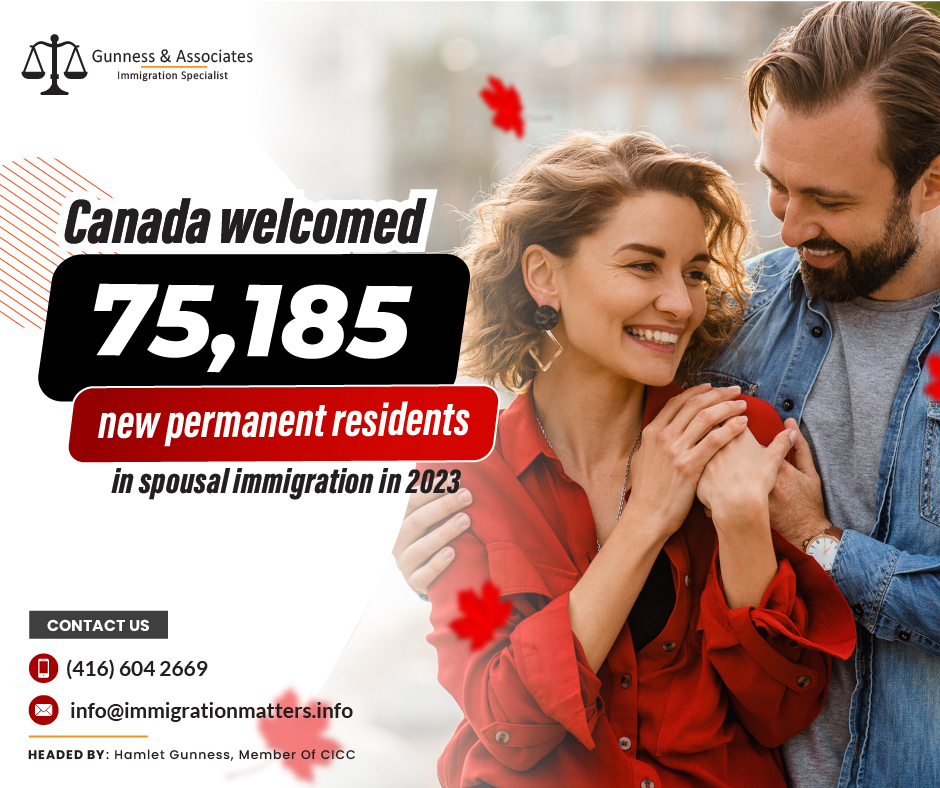
Canada welcomed 75,185 new permanent residents in spousal immigration

According to the latest statistics from IRCC data revealed a significant surge in spousal immigration to Canada in 2023, with a 17.2% increase compared to the previous year. In 2023, Canada experienced a remarkable surge in immigrants entering the country through the spousal sponsorship program, according to data released by Immigration, Refugees, and Citizenship Canada (IRCC). The numbers revealed a substantial increase of 17.2% in the influx of new permanent residents compared to 2022, reaching a total of 75,185 individuals. This surge in spousal immigration stands out, especially when considering that it outpaced the overall immigration growth rate of 7.8% in Canada during the same period. The data from IRCC’s report underscores the significance of the spousal sponsorship program as a key avenue for individuals seeking permanent residency in Canada. Notably, the final quarter of 2023 witnessed an even more pronounced increase, with a staggering 27.4% rise in the number of spouses and common-law partners entering the country. This surge indicates a growing trend of couples choosing Canada as their destination for starting a new life together. Among the provinces, Ontario emerged as the top destination for spousal immigrants, welcoming 39,820 spouses in the previous year. The province’s appeal can be attributed to various factors, including its diverse job opportunities, vibrant communities, and robust support systems for newcomers. This notable increase in spousal immigration has significant implications for Canada’s demographic landscape, social fabric, and economy. It reflects the country’s commitment to family reunification and underscores its reputation as an attractive destination for immigrants seeking to build a better future for themselves and their loved ones. The surge in spousal immigration to Canada in 2023, as evidenced by the 17.2% increase in new permanent residents, highlights the country’s enduring appeal as a destination for couples seeking to reunite and establish their lives together. With Ontario leading the way as the preferred province for spousal immigrants, Canada continues to demonstrate its welcoming stance and commitment to fostering diverse and inclusive communities. Join our RSS Feed    If you want to know more details about “Canada welcomed 75,185 new permanent residents in spousal immigration” you can contact one of our immigration specialists at  Gunness & Associates.   Tel: (416) 604-2669  Email: info@test.immigrationmatters.info   Gunness & Associates has helped thousands of people successfully immigrate to Canada with their families. Our skilled and experienced immigration experts have the expertise to accurately examine your case and advise you on the best method of proceeding to serve your needs.   For honest and straightforward advice, contact the experts at Gunness & Associates Get a free Assessment  Join our newsletter and get up-to-date immigration news Click here All rights reserved ©2023 Gunness & Associates

Canada's Parents and Grandparents Program

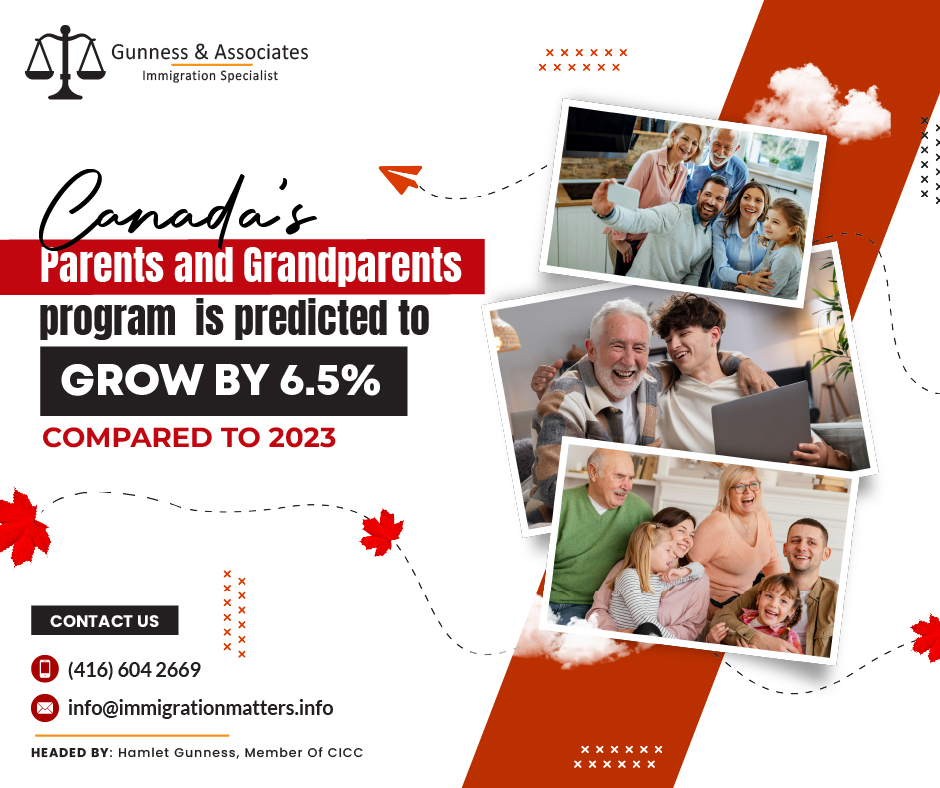
Canada’s Parents and Grandparents Program is predicted to grow by 6.5%

Canada’s Parents and Grandparents Program (PGP) saw a 32% drop in arrivals in November following a strong October, according to Immigration, Refugees and Citizenship Canada. Arrivals fell from 2,530 in October to 1,720 in November, coinciding with a 12.4% drop in overall monthly immigration.  Despite this, the PGP welcomed 26,600 new permanent residents in the first 11 months of the year, potentially reaching 29,018 by year-end, a 6.4% increase from the previous year. Ontario received the majority of PGP arrivals, with 12,660 parents and grandparents settling there. During that time, the following provinces and territories attracted the following number of new permanent residents under the PGP: 50 – Newfoundland and Labrador 10 – Prince Edward Island 175 – Nova Scotia 45 – New Brunswick 2,200 – Quebec has  1,020 – Manitoba  680 – Saskatchewan  4,820 – Alberta  4,080 – British Columbia  25 – Yukon  15 – Northwest Territories Super Visa for Canada’s Parents and Grandparents Program A super visa allows you to visit your children or grandchildren for up to 5 years. It is a visa that allows multiple entries for a period of up to ten years. A super visa has specific requirements, including the need for health insurance. To be eligible, you must meet all of the requirements. Super Visa holders are allowed to stay in Canada for a maximum of two years during that time. On the other hand, a regular visa for visitors typically has a maximum validity of six months. Citizens of countries exempt from visa requirements may still find the Super Visa program beneficial. Normally, visitors from visa-exempt nations are allowed entry into Canada for six months without the need for a visitor’s visa. Join our RSS Feed    If you want to know more details about the “Canada’s Parents and Grandparents Program is predicted to grow by 6.5% compared to 2023″ you can contact one of our immigration specialists at  Gunness & Associates.   Tel: (416) 604-2669  Email: info@test.immigrationmatters.info   Gunness & Associates has helped thousands of people successfully immigrate to Canada with their families. Our skilled and experienced immigration experts have the expertise to accurately examine your case and advise you on the best method of proceeding to serve your needs.   For honest and straightforward advice, contact the experts at Gunness & Associates Get a free Assessment  Join our newsletter and get up-to-date immigration news Click here All rights reserved ©2023 Gunness & Associates

family class applicants

IRCC eased work permit application requirements for family class applicants

Immigration, Refugees and Citizenship Canada (IRCC) has issued an update regarding the public policy for spouses or common-law partners in Canada (SCLPC) class, as well as family class applicants applying within Canada. As of December 7, 2023, to prevent family class applicants from losing their status while awaiting acknowledgment of receipt for their permanent residence application, the IRCC will now accept open work permit applications without the acknowledgment of receipt.  This policy applies to applicants who can provide the necessary proof that their work permit, study permit, or temporary resident status is due to expire within two weeks. Public Policy for Spouses or Common-law Partners in Canada This public policy allows sponsored spouses and partners to support their families and build a life together in Canada. Sponsored spouses and partners, as well as their family members, contribute to the social and economic well-being of Canadian citizens and permanent residents. When a foreign national applies for an open work permit under the Spouse or Common-Law Partner in Canada Class or the Family Class, and their family members have a valid temporary resident status, have maintained their status, or are eligible for and have applied to restore their status and have the same residential address as their sponsor in Canada. Family Class Immigration The family class immigration program’s goal is to reunite Canadian citizens and permanent residents with close family members. By agreeing to support sponsored members of the family class, the sponsor promises that they will meet the basic needs of their family members for a set period of time so that they do not have to rely on social assistance. Priority is given to sponsorship applications involving spouses, common-law or conjugal partners, and dependent children. Adopted children, children to be adopted, and orphans are given priority in sponsorship applications, as they frequently involve minors without parental care. Join our RSS Feed    If you want to know more details about “IRCC eased work permit application requirements for family class applicants” you can contact one of our immigration specialists at  Gunness & Associates.   Tel: (416) 604-2669  Email: info@test.immigrationmatters.info   Gunness & Associates has helped thousands of people successfully immigrate to Canada with their families. Our skilled and experienced immigration experts have the expertise to accurately examine your case and advise you on the best method of proceeding to serve your needs.   For honest and straightforward advice, contact the experts at Gunness & Associates Get a free Assessment  Join our newsletter and get up-to-date immigration news Click here All rights reserved ©2023 Gunness & Associates

pilot program

Ottawa extended the pilot program, allowing more families to reunion

Ottawa extended the pilot program, allowing more families to reunite Foreign nationals applying for Canadian immigration must declare and examine all family members, even if they are not accompanying them. Failing to report non-accompanying members may lead to a sponsorship ban under specific regulations.  To address this, a temporary pilot project was introduced on May 31, 2019, and extended until September 10, 2023, to facilitate further analysis and potential regulation changes.  On October 30, 2023, the Government of Canada extended the pilot program exempting certain family class and the spouse or common-law partners in Canada class permanent residence applicants from paragraph R117(9)(d) or R125(1)(d) of the Immigration and Refugee Protection Regulations (IRPR). About the pilot program exempting certain family class and the spouse or common-law partners in Canada Foreign nationals who want to come to Canada have to register and have all of their family members (spouse or common-law partner, and children) examined, even if they are not accompanying the principal applicant. Failure to have a non-accompanying family member examined results in a lifelong exclusion from promoting that person under the family or spouse or common-law partner in Canada (SCLPC) classes, according to paragraphs R117(9)(d) or R125(1)(d) of the Immigration and Refugee Protection Regulations (IRPR). To address potential concerns about the impact of this provision on families, the Government of Canada announced a two-year pilot project through a temporary public policy to facilitate the immigration of certain sponsored foreign nationals who are excluded under paragraph R117(9)(d) or R125(1)(d). This public policy was announced by the Minister of Immigration, Refugees, and Citizenship on May 31, 2019, and was originally scheduled to be in effect from September 9, 2019, to September 9, the year 2020. It was later extended for an additional three years and was started on September 10, 2023, to allow for more time to conduct additional analysis and pursue potential regulatory changes. Join our RSS Feed    Want to know more details about “Ottawa extended the pilot program, allowing more families to reunite” you can contact one of our immigration specialists at  Gunness & Associates.   Tel: (416) 604-2669  Email: info@test.immigrationmatters.info Gunness & Associates has helped thousands of people successfully immigrate to Canada with their families. Our skilled and experienced immigration experts have the expertise to accurately examine your case and advise you on the best method of proceeding to best serve your needs.   For honest and straightforward advice, contact the experts at Gunness & Associates Get a free Assessment  Join our newsletter and get up-to-date immigration news Click here All rights reserved ©2023 Gunness & Associates

Spousal sponsorship

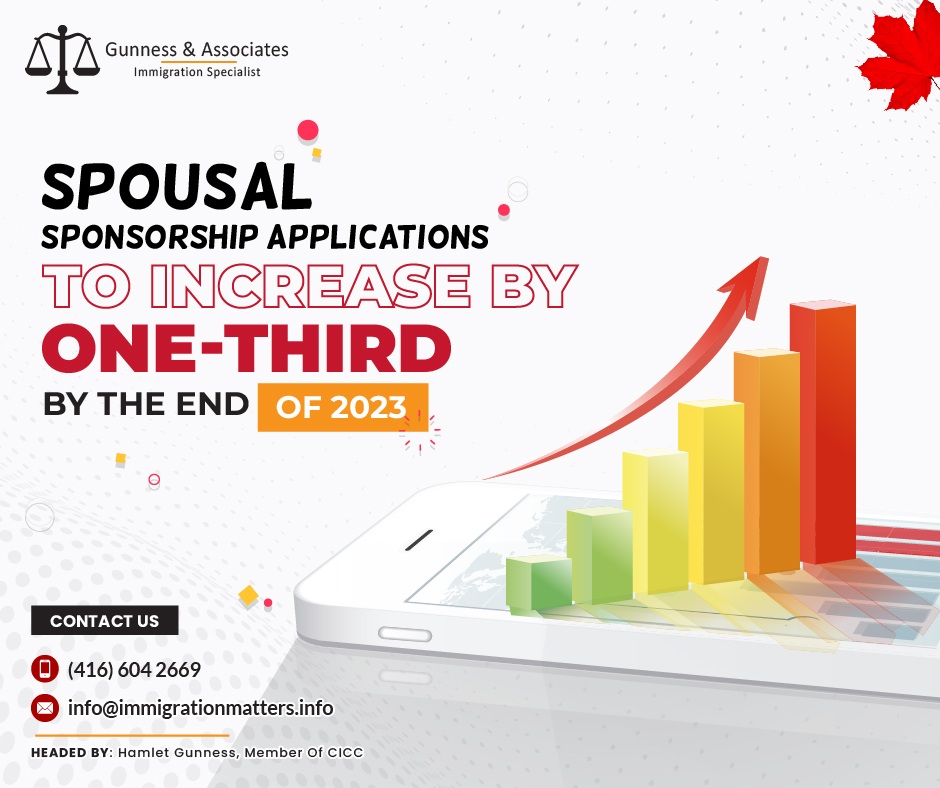
Spousal sponsorship applications to increase by one-third by the end of 2023

In July, the number of Spousal sponsorship applications and common-law partners who immigrated to Canada remained almost the same as in June. The most recent data from Immigration, Refugees and Citizenship Canada (IRCC) indicates that 6,215 new permanent residents arrived in Canada through spousal sponsorship immigration in July, while 50,015 new permanent residents have arrived through this immigration program by the end of July.  This is an increase of 21.6 percent from the 41,145 new permanent residents who came through spousal sponsorships in the first seven months of 2022. If the trend continues, Canada is expected to welcome 85,740 new permanent residents through spousal sponsorships, a 33.7 percent increase from last year’s 64,145 immigrants who arrived through the same program. The anticipated volume of immigration under spousal sponsorship would be higher than the cap on spousal sponsorships set by Ottawa for this year. Are you planning to sponsor your spouse, partner, or dependent children? Fill out the form to make your sponsorship process smooth for your family. Ottawa has previously established a maximum of 84,000 new permanent residents under programs to sponsor spouses, partners, and children in its Immigration Levels Plan for the years 2023 to 2025. 78,000 new permanent residents are the desired number for that group of immigrants this year. In the first seven months of this year, 26,270 spouses became residents of Ontario, the province with the largest population in Canada, under the spousal sponsorship program. Under the spouse sponsorship program during that time, the following number of new permanent residents were drawn to the other provinces and territories: Newfoundland and Labrador – 110 Prince Edward Island – 90 Nova Scotia – 570 New Brunswick – 335 Quebec – 5,335 Manitoba – 1,375 Saskatchewan – 860 Alberta – 6,430 British Columbia – 8,545 Yukon – 55 Northwest Territories – 35 Nunavut – 5   What is the Spousal Sponsorship Program? A Canadian citizen or permanent resident may sponsor their spouse to immigrate to Canada and establish a permanent residence. In Canada, we are aware of the value of intact families. Applications seeking spousal sponsorship are therefore given top attention. You may be able to sponsor your spouse, partner, or dependent children to immigrate to Canada as permanent residents if you meet the requirements. You must be able to in order to: help them out financially check to see if they require government social assistance Join our RSS Feed    Want to know more details about “Spousal sponsorship applications to increase by one-third by the end of 2023” you can contact one of our immigration specialists at  Gunness & Associates.   Tel: (416) 604-2669  Email: info@test.immigrationmatters.info   Gunness & Associates has helped thousands of people successfully immigrate to Canada with their families. Our skilled and experienced immigration experts have the expertise to accurately examine your case and advise you on the best method of proceeding to best serve your needs.   For honest and straightforward advice, contact the experts at Gunness & Associates Get a free Assessment  Join our newsletter and get up-to-date immigration news Click here All rights reserved ©2023 Gunness & Associates

Last year, the number of family members reunited with their loved ones in Canada through the Parents and Grandparents Program (PGP) skyrocketed - more than doubling its previous record set before the COVID-19 pandemic. According to the newest records from Immigration, Refugees and Citizenship Canada (IRCC), an impressive 27,195 new permanent residents arrived in Canada through the PGP last year or 11,740 more than in 2021, a 131.6% rise. The PGP, which relies upon Canadian relatives sponsoring the parents and grandparents of immigrants, has been gradually rebuilding its numbers following the massive reduction in immigration due to public health protocols and travel restrictions. The number of new arrivals under the PGP similarly dropped as overall immigration did, from 341,175 new permanent residents in 2019, the full year before the pandemic, to only 184,595 newcomers in 2020. In comparison to 2019, when the PGP welcomed 22,010 new permanent residents, the program only saw 10,455, or a 52.5% decrease, in the first year of the pandemic. The following year, with a then-record-breaking 406,040 new permanent residents, overall immigration roared back to life. However, despite that year's significant increase in immigration, the number of new arrivals under the PGP only increased by a modest 12.3% to 11,740 new permanent residents in 2021. The number of immigrants entering Canada through the PGP at this time is approximately two times higher than it was in 2015, when 15,490 parents and grandparents may be sponsored to immigrate. There's little chance that the PGP numbers will be even higher this year given Ottawa's significantly higher immigration targets for the upcoming years. Canada plans to welcome 1.45 million immigrants within three years  Ottawa's immigration levels plan for the years 2023–2025 sets a target of 465,000 new permanent residents for 2023. 2024 will see 485,000 new permanent residents enter, following 500,000 more in 2025. Overall, 1.45 million immigrants will arrive in Canada during the next three years. The PGP requires applicants to pay $1,050 to sponsor a parent or grandparent, and the process can take up to 39 months. The sponsors must provide biometrics after submitting their applications. The time it took to submit these biometrics is included in the processing time. After submitting an interest in sponsoring these relatives, a Canadian citizen or permanent resident will receive an invitation to apply (ITA) and will then need to send two applications to the PGP: the sponsorship application, and; the permanent residence application If those applications are accepted, the sponsor enters into an agreement that begins the day the sponsor becomes a Canadian permanent resident. Eligibility requirements to sponsor the parents and grandparents  you can sponsor your own parents and relatives If: You are invited to apply. You are at least 18 years old. You're a Canadian Permanent resident. You are a Canadian citizen, a permanent resident of Canada, or a person who has a Canadian Indian Act registered. You have sufficient money to support the people you want to support. You meet all additional requirements specified in the Immigration and Refugee Protection Act and its regulations. Want to know more details about “Canada accepted twice more the parents and grandparents in 2022” you can contact one of our immigration specialists at  Gunness & Associates. Tel: (416) 604-2669  Email: info@test.immigrationmatters.info Gunness & Associates has helped thousands of people successfully immigrate to Canada with their families. Our skilled and experienced immigration experts have the expertise to accurately examine your case and advise you on the best method of proceeding to best serve your needs. For honest and straightforward advice, contact the experts at Gunness & Associates. Get a free Assessment  Join our newsletter and get up-to-date immigration news Click here All rights reserved ©2022 Gunness & Associate

Canada accepted twice more the parents and grandparents in 2022

Last year, the number of family members reunited with their loved ones in Canada through the Parents and Grandparents Program (PGP) skyrocketed – more than doubling its previous record set before the COVID-19 pandemic. According to the newest records from Immigration, Refugees and Citizenship Canada (IRCC), an impressive 27,195 new permanent residents arrived in Canada through the PGP last year or 11,740 more than in 2021, a 131.6% rise. The PGP, which relies upon Canadian relatives sponsoring the parents and grandparents of immigrants, has been gradually rebuilding its numbers following the massive reduction in immigration due to public health protocols and travel restrictions. The number of new arrivals under the PGP similarly dropped as overall immigration did, from 341,175 new permanent residents in 2019, the full year before the pandemic, to only 184,595 newcomers in 2020. In comparison to 2019, when the PGP welcomed 22,010 new permanent residents, the program only saw 10,455, or a 52.5% decrease, in the first year of the pandemic. The following year, with a then-record-breaking 406,040 new permanent residents, overall immigration roared back to life. However, despite that year’s significant increase in immigration, the number of new arrivals under the PGP only increased by a modest 12.3% to 11,740 new permanent residents in 2021. The number of immigrants entering Canada through the PGP at this time is approximately two times higher than it was in 2015, when 15,490 parents and grandparents may be sponsored to immigrate. There’s little chance that the PGP numbers will be even higher this year given Ottawa’s significantly higher immigration targets for the upcoming years.   Canada plans to welcome 1.45 million immigrants within three years  Ottawa’s immigration levels plan for the years 2023–2025 sets a target of 465,000 new permanent residents for 2023. 2024 will see 485,000 new permanent residents enter, following 500,000 more in 2025. Overall, 1.45 million immigrants will arrive in Canada during the next three years. The PGP requires applicants to pay $1,050 to sponsor a parent or grandparent, and the process can take up to 39 months. The sponsors must provide biometrics after submitting their applications. The time it took to submit these biometrics is included in the processing time. After submitting an interest in sponsoring these relatives, a Canadian citizen or permanent resident will receive an invitation to apply (ITA) and will then need to send two applications to the PGP: the sponsorship application, and; the permanent residence application If those applications are accepted, the sponsor enters into an agreement that begins the day the sponsor becomes a Canadian permanent resident.   Eligibility requirements to sponsor the parents and grandparents  you can sponsor your own parents and relatives If: You are invited to apply. You are at least 18 years old. You’re a Canadian Permanent resident. You are a Canadian citizen, a permanent resident of Canada, or a person who has a Canadian Indian Act registered. You have sufficient money to support the people you want to support. You meet all additional requirements specified in the Immigration and Refugee Protection Act and its regulations.   Want to know more details about “Canada accepted twice more parents and grandparents in 2022” you can contact one of our immigration specialists at  Gunness & Associates.   Tel: (416) 604-2669  Email: info@test.immigrationmatters.info   Gunness & Associates has helped thousands of people successfully immigrate to Canada with their families. Our skilled and experienced immigration experts have the expertise to accurately examine your case and advise you on the best method of proceeding to best serve your needs.   For honest and straightforward advice, contact the experts at Gunness & Associates. Get a free Assessment  Join our newsletter and get up-to-date immigration news Click here All rights reserved ©2022 Gunness & Associate

IRCC processing times

IRCC processing times for citizenship and family sponsorship applications

IRCC processing times for citizenship and family sponsorship applications were updated on February 7, 2023, Immigration, Refugees and Citizenship Canada (IRCC) updated the application processing times to help applicants know how long their application processing may take until a decision is made.  According to the update, IRCC processes citizenship applications within 23 months. Application processing times for spousal sponsorship applications were around 14-16 months, while PR applications for parents and grandparents took 39 months.  The latest IRCC data reveals that the Canadian immigration backlog was at a staggering 918,300, and 1.055 million applications were processed within IRCC service standards. These processing times are designed to provide updated weekly processing times based on information collected over the past six months. Furthermore, the application processing period begins when it is received by the IRCC and ends when the immigration officer decides whether to move forward with the application.   IRCC processing times for Citizenship applications  Application Type Current Processing Time Change From Last Week Citizenship grant 23 months No Change Citizenship certificate (proof of citizenship) 14 months No Change Resumption of citizenship 24 months No Change Renunciation of Citizenship 15 months No Change The search for citizenship records 16 months No Change   IRCC processing times for family sponsorship applications Application Type Current Processing Time Change From Last Week Spouse or common-law partner living outside Canada 16 months No Change Spouse or common-law partner living in Canada 14 months No Change Parents or Grandparents PR 39 months No Change   Want to know more details about “IRCC processing times for citizenship and family sponsorship application updates” you can contact one of our immigration specialists at  Gunness & Associates.   Tel: (416) 604-2669  Email: info@test.immigrationmatters.info   Gunness & Associates has helped thousands of people successfully immigrate to Canada with their families. Our skilled and experienced immigration experts have the expertise to accurately examine your case and advise you on the best method of proceeding to best serve your needs.   For honest and straightforward advice, contact the experts at Gunness & Associates. Get a free Assessment  Join our newsletter and get up-to-date immigration news Click here All rights reserved ©2022 Gunness & Associate

Ottawa updated the guidance for Super Visa Holders

Ottawa updated the guidance for Super Visa Holders

On July 28, 2022, the Government of Canada updated the guidance for the multiple entry temporary resident visa (TRV) for parents and grandparents. According to the update, super visa holders’ every entry to Canada should be for a duration of up to 5 years.  The super visa is a 10-year multiple-entry TRV that is open to eligible applicants for up to 10 years and has authorized stays of up to 5 years for each entry.  The changes to the program came into force on July 4, 2022, and were made in compliance with the authority granted in subsection 15(4) of the Immigration and Refugee Protection Act (IRPA). Join our newsletter and get up-to-date immigration news Click here.   Eligibility Criteria for Super Visa Holders An applicant would be eligible for a super visa if they meet the requirements for temporary residence in Canada as a visitor and they provide the additional required documentation. To be eligible for a super visa, applicants have to prove the following: their relationship to the child or grandchild an immigration medical examination and of being admissible to Canada on health grounds private medical insurance from a Canadian insurance company valid for a minimum period of 1 year from the date of entry a letter of invitation written and signed by the host child or grandchild financial support by the child or grandchild   Get a free Assessment   Decade after decade, the super visa has remained a popular and lucid option for Canadian citizens and permanent residents to reunite with their parents and grandparents in Canada. Every year IRCC (Immigration, Refugees and Citizenship Canada) annually issues approximately 17,000 super visas. To know more details about applying for TRV or updated guidance for the super visa holders you can contact one of our immigration specialists at Gunness & Associates.   Tel: (416) 604-2669 Email: info@test.immigrationmatters.info All rights reserved ©2022 Gunness & Associates

Canada updated Instructions for the Spouse or Common-Law Partner in Canada Class

Instructions for the Spouse or Common-Law Partner in Canada Class Updated

On June 8, 2022, the Government of Canada updated instructions regarding determining membership in the spouse or common-law partner in the Canada class. The revised instructions for circumstances when there is a relationship breakdown and the primary applicant (sponsored spouse) wishes to proceed with their permanent residence application.  The conversion to humanitarian and compassionate grounds is applicable for these cases. In addition, the instructions have been updated to include further clarification on these cases under the exemption from the requirement to have temporary resident status. The foreign national meets the membership requirements of the spouse or common-law partner in the Canadian class if all of the following apply if they: are the spouse or common-law partner of a sponsor (as defined in R130) and cohabit with that sponsor in Canada (Common-law partners must have cohabited for at least one year) have temporary resident status  are the subject of a sponsorship application if they are not excluded from the class under R125 concerning excluded relationships   Lawful temporary resident status in Canada To become members of the class for eligibility, applicants in the spouse or common-law partner in Canada class must have valid temporary resident status on the date of application and on the date they receive permanent resident status. Exemption from requirement to have temporary resident status The spousal public policy facilitates the processing of genuine out-of-status spouses or common-law partners in the spouse or common-law partner in the Canada class who meet the other eligibility requirements of the class. Applicants who are covered under the public policy should be processed according to the provisions of the spousal public policy. Applicants who do not have temporary resident status and who are not eligible under the spousal public policy can be removed at any time. Further, the spousal policy does not change the requirement to seek necessary authorization to visit Canada or to work or study here. If the applicant cannot be exempted from the legal temporary resident status requirement under the spousal public policy they may request an exemption from the requirement to have temporary resident status in Canada on Humanitarian and compassionate grounds. See Humanitarian and Compassionate considerations for applicants in the spouse or common-law partner in Canada class. Public policy cases where the relationship is ongoing but the applicant has been deported or where the applicant and sponsor are in an excluded relationship (for example, R4, R5, R125 (1) (d)) should not result in the application being converted to a humanitarian and compassionate in-Canada application. Instead, these humanitarian and compassionate grounds requests should be considered in the context of the spouse or common-law partner in Canada class.   Temporary resident requirement in Canada Other requirements applicable to a foreign national, who apply to remain in Canada as a member of the Spouse or Common-law Partner in Canada Class: a foreign national is not considered a spouse or common-law partner if the marriage or common-law partnership is not genuine or was entered into primarily for the purpose of acquiring any status or privilege under the Act [R4] a foreign national is not considered a spouse or common-law partner if a new conjugal relationship was begun after a previous marriage or common-law partnership with that person was dissolved primarily to acquire any status or privilege under IRPA [R4.1] a foreign national must not be the subject of enforcement proceedings or a removal order for reasons other than “lack of status” (see definition of “lack of status” under the spousal public policy). Although most persons who are under a removal order or facing enforcement proceedings for reasons other than “lack of status” are eligible for initial consideration under the public policy as they meet the criteria in R124, they cannot be granted permanent residence as they will be found inadmissible in the second stage of processing a foreign national becomes a permanent resident if they meet the requirements of R72 a foreign national and their family members must meet admissibility requirements (R72), however, they are exempt from inadmissibility on health grounds due to excessive demand on health and social services a foreign national must have a valid passport or travel document by the time permanent residence is granted (R72) Noted: “Lack of status” may also refer to persons who have overstayed a temporary resident permit. Get a free assessment for immigration to Canada. This is quite complicated to immigrate to Canada without any specialist help.  Contact Immigration Specialists at Gunness & Associates and get free migration consultancy for coming to Canada. Tel: (416) 604-2669 Email: info@test.immigrationmatters.info Join our free newsletter click here All rights reserved ©2022 Gunness & Associates