Study in Canada

partners of study permit holders

New updates for spouses and common-law partners of study permit holders

On March 19, 2024, Immigration, Refugees and Citizenship Canada (IRCC) updated rules for spouses and common-law partners of study permit holders. The changes apply to: partners of full-time students (designating the work performed by them as necessary) in graduate programs, professional degree programs, and those with a valid open work permit under the C42 category extending their permit as partners of students in a Post-Graduation Work Permit (PGWP) eligible program at a designated institution.  On January 22, 2024, the department made several changes to Canada’s international student program. IRCC stated that spouses of international students enrolled in undergraduate and college programs will no longer be eligible for SOWPs. As of March 19, partners and spouses of international students can only apply for a SOWP if their sponsor is pursuing a master’s or doctoral degree at a Canadian university or polytechnic institution. Applications received before March 18, 2024, are unaffected by this change. Eligibility for Spouses and Common-law Partners of Study Permit Holders To be eligible under administrative code C42, the principal foreign national must fulfill all of the following requirements: Have a valid study permit or have been provisionally approved for one (if applying as a family group from outside Canada). be a full-time student or have proof of enrollment in full-time courses at a designated learning institution. be accepted or enrolled in a post-graduate study program and institution that is eligible for a work permit. be physically present in Canada or provide proof that they intend to reside there while studying physically Sponsor your Family for Canadian Immigration Some exceptions apply to undergraduate students’ spouses or partners. Spouses of undergraduate students in one of the following professional degree programs at a university may also apply: Doctor of Dental Surgery (DDS or DMD) Bachelor of Laws or Juris Doctor (LLB, JD, BCL). Doctor of Medicine (MD). Doctor of Optometry (OD) Pharmacy (PharmD, BS, BSc, BPharm) Doctor of Veterinary Medicine (DVM) Bachelor of Science in Nursing (BScN, BSN, or BNSc). Bachelor of Education (B.Ed. Bachelor of Engineering (B. Eng., BE, or BASc). Join our RSS Feed    If you want to know more details about “IRCC announced new updates for spouses and common-law partners of study permit holders” you can contact one of our immigration specialists at  Gunness & Associates.   Tel: (416) 604-2669  Email: info@test.immigrationmatters.info   Gunness & Associates has helped thousands of people successfully immigrate to Canada with their families. Our skilled and experienced immigration experts have the expertise to accurately examine your case and advise you on the best method of proceeding to serve your needs.   For honest and straightforward advice, contact the experts at Gunness & Associates Get a free Assessment  Join our newsletter and get up-to-date immigration news Click here All rights reserved ©2023 Gunness & Associates
Ontario universities

Ontario universities seek to increase international student enrolment

Ontario universities are requesting 35% of the capped study permit applications, equating to 82,250 of 235,000 applications from international students. The Council of Ontario Universities (COU) seeks to distribute these allocations based on each university’s proportion of international student enrollment. The COU aims to welcome 28,000 international students next year, maintaining their representation at around 20% of all students.  This initiative comes as part of a broader strategy by the COU to distribute study permit allocations based on each university’s current proportion of international student enrollment. By doing so, they hope to maintain a diverse and inclusive learning environment across Ontario’s higher education landscape. The benefits of attracting more international students extend beyond cultural enrichment. These students contribute to the academic discourse, bringing diverse perspectives and experiences that enrich classroom discussions and research endeavors. Moreover, their presence enhances the overall campus experience for both domestic and international students alike, fostering a vibrant and cosmopolitan atmosphere. In addition to the academic advantages, international students also play a vital role in Ontario’s economy. They inject billions of dollars annually into the local economy through tuition fees, living expenses, and other expenditures, supporting jobs and businesses across the province. As Ontario’s universities navigate the complexities of the global education landscape, their commitment to increasing international student enrollment remains unwavering. Despite the challenges posed by the capped study permit applications, they are determined to continue attracting top talent from around the world, enriching their campuses and communities in the process. By prioritizing diversity, inclusivity, and academic excellence, Ontario’s universities are poised to remain at the forefront of global higher education. Join our RSS Feed    If you want to know more details about “Ontario universities seek to increase international student enrolment” you can contact one of our immigration specialists at  Gunness & Associates.   Tel: (416) 604-2669  Email: info@test.immigrationmatters.info   Gunness & Associates has helped thousands of people successfully immigrate to Canada with their families. Our skilled and experienced immigration experts have the expertise to accurately examine your case and advise you on the best method of proceeding to serve your needs.   For honest and straightforward advice, contact the experts at Gunness & Associates Get a free Assessment  Join our newsletter and get up-to-date immigration news Click here All rights reserved ©2023 Gunness & Associates

new Changes to the PGWP

IRCC implemented the new Changes to the PGWP

As of February 15, 2024, the Government of Canada implemented new Changes to the PGWP. From this date forward, students who have completed a master’s degree program, even under two years, can qualify for a 3-year PGWP, provided they meet all other eligibility criteria.  However, starting September 1, 2024, students enrolled in curriculum licensing agreement programs will no longer be eligible for a PGWP. In addition, the special measures for distance learning and PGWP validity have been extended until August 31, 2024. Details of the new Changes to the PGWP One of the most prominent modifications pertains to the duration of PGWPs for master’s degree graduates. Previously, the length of the permit was contingent on the duration of the study program, with a maximum allowance of three years. However, under the new guidelines, even students who have completed a master’s degree program spanning less than two years can now qualify for a 3-year PGWP, provided they fulfill all other eligibility requirements. This expansion opens doors for a broader spectrum of graduates, empowering them with extended opportunities to explore and secure employment in Canada post-graduation. For assistance, to study in Canada get a free assessment On the flip side, beginning September 1, 2024, students enrolled in curriculum licensing agreement programs will face a setback as they will no longer be eligible for a PGWP. This change underscores the importance of staying informed about evolving regulations and making strategic decisions regarding academic pursuits and career aspirations. Furthermore, in response to the evolving landscape of education amidst the global pandemic, the government has extended special measures for distance learning and PGWP validity until August 31, 2024. This extension acknowledges the ongoing challenges faced by students and institutions alike, ensuring continued support and flexibility in navigating the uncertainties brought about by the pandemic. The recent adjustments to the PGWP program by the Immigration, Refugees, and Citizenship Canada (IRCC) mark a significant milestone in facilitating pathways for international students to contribute to Canada’s workforce and economy. While these changes present new opportunities for some, it’s crucial for students and stakeholders to remain vigilant and adapt to the evolving regulatory landscape to make informed decisions about their academic and professional journeys. Stay updated, stay informed, and seize the opportunities that lie ahead. Canada has capped the international student intake for 2024-2025 On January 22, 2024, Canada’s Minister of Immigration, Refugees and Citizenship Canada (IRCC), Marc Miller, announced a two-year cap on international student permit applications to stabilize growth. For 2024, the cap will result in around 360,000 approved permits, a 35% decrease from 2023. These measures do not apply to master’s, doctoral, elementary, and secondary education students and current permit holders. Read More Join our RSS Feed    If you want to know more details about “IRCC implemented the new Changes to the PGWP” you can contact one of our immigration specialists at  Gunness & Associates.   Tel: (416) 604-2669  Email: info@test.immigrationmatters.info   Gunness & Associates has helped thousands of people successfully immigrate to Canada with their families. Our skilled and experienced immigration experts have the expertise to accurately examine your case and advise you on the best method of proceeding to serve your needs.   For honest and straightforward advice, contact the experts at Gunness & Associates Get a free Assessment  Join our newsletter and get up-to-date immigration news Click here All rights reserved ©2023 Gunness & Associates
International Student Program Changes

Additional information about the International Student Program Changes

On February 5, 2024, IRCC provided further details on the recent announcement of the International Student Program Changes; Canada aims to address the unsustainable growth in recent years while ensuring a positive experience for international students. As of January 22, 2024, post-secondary international students at the college or undergraduate level must now include a Provincial Attestation Letter (PAL) from a province or territory with their study permit application.  Secondary, effective February 15, 2024, graduates from master’s degree programs less than two years in length are eligible for an extended 3-year PGWP. This change supports their transition to Canada’s labor market and potential permanent residence. Other PGWP lengths remain aligned with the study program’s duration. IRCC has restricted PGWPs for public-private partnership college programs.  Finally, open work permit eligibility for spouses and common-law partners of international students will be updated. These reforms aim to promote sustainable population growth in Canada, improve system integrity, and ensure a positive experience for international students. Over a million International students studied at Canadian universities Active study permits for international students in Canada grew by 27% to 1,028,850 in 2023, exceeding the government’s projection of 950,000. Ontario hosted 51% of these students, followed by British Columbia (19.5%) and Quebec (11.5%).  However, this rapid growth has created challenges like housing shortages and strain on the healthcare system. This has led to a planned 35% decrease in approved study permits for 2024. The cap will be based on each province’s population, leading to significant changes in student recruitment across provinces. This move is supported by a Nanos Research poll indicating that 55% of Canadians favor accepting fewer international students. International student numbers have increased dramatically, from 637,855 in 2019 to 807,260 in 2022, prompting concerns that many students, including those from India, are being exploited by agents who recruit them to attend private colleges in Canada with subpar standards, support, and facilities.  More than 60,000 international students became permanent residents of Canada in 2023, a 9,670 increase over the 52,740 international graduates who became international students in 2022, according to IRCC data. Join our RSS Feed    If you want to know more details about “IRCC clarified additional information about International Student Program reforms” you can contact one of our immigration specialists at  Gunness & Associates.   Tel: (416) 604-2669  Email: info@test.immigrationmatters.info Gunness & Associates has helped thousands of people successfully immigrate to Canada with their families. Our skilled and experienced immigration experts have the expertise to accurately examine your case and advise you on the best method of proceeding to serve your needs.   For honest and straightforward advice, contact the experts at Gunness & Associates Get a free Assessment  Join our newsletter and get up-to-date immigration news Click here All rights reserved ©2023 Gunness & Associates
PTE for Canadian immigration

Ottawa now accepts the PTE for Canadian immigration

From January 30, 2024, Canada now accepts the PTE for Canadian immigration for all immigration pathways, aside from the Student Direct Stream (SDS), which will accept the Pearson Test of English (PTE) Core test. This includes Provincial Nominee Program (PNP) candidates, those in Express Entry managed programs, and individuals needing a language test for Canadian immigration or citizenship (excluding SDS).  What is the PTE for Canadian immigration? The PTE Core is a two-hour computer-based language test assessing everyday English skills in speaking, writing, reading, and listening skills. The PTE Core replaces the PTE Essential test, and candidates should ensure they take the correct test for their program. Get a Free Canada Immigration assessment To reduce the risk of bias, the PTE for Canadian immigration tests is scored by both humans and AI. Test results can be obtained within two days. The PTE Core is divided into three parts. Speaking and writing (50 minutes); Reading (30 minutes); and Listening (30 minutes). The PTE Core replaced the previous PTE Essential test, which was approved for Canadian immigration last year. Pearson, like other approved language testing organizations, provides a variety of tests (for example, PTE Academic). Immigration candidates are advised to take the appropriate test for their chosen program. Other accepted Tests for Canadian immigration With the addition of the PTE Core, Immigration, Refugees, and Citizenship Canada (IRCC) now accepts five different language tests for immigration purposes. They are: CELPIP General Test (English); IELTS General Training (English) PTE Core (English); TEF Canada; and TCF Canada (french). All five of these tests assess language proficiency in four areas: reading, writing, listening, and speaking. Depending on the program for which they apply, candidates may be required to meet different criteria within these four skills. Join our RSS Feed    If you want to know more details about “Ottawa now accepts the PTE for Canadian immigration” you can contact one of our immigration specialists at  Gunness & Associates.   Tel: (416) 604-2669  Email: info@test.immigrationmatters.info   Gunness & Associates has helped thousands of people successfully immigrate to Canada with their families. Our skilled and experienced immigration experts have the expertise to accurately examine your case and advise you on the best method of proceeding to serve your needs.   For honest and straightforward advice, contact the experts at Gunness & Associates Get a free Assessment  Join our newsletter and get up-to-date immigration news Click here All rights reserved ©2023 Gunness & Associates
International students became permanent

355,000 International students became permanent residents, within the last 3 years

According to IRCC, over 355,000 International students became permanent residents in Canada between 2021 and 2023. Over 627,000 temporary residents gained permanent residency (PR) in the same period. In 2020, Canada admitted less than half the current number of immigrants, at 184,370.  However, immigration quotas for 2024 and 2025 are set at 485,000 and 500,000, respectively, despite housing concerns among Canadians. Many are questioning the feasibility of accommodating half a million immigrants yearly amidst a housing crisis.  International student intake for 2024-2025 On January 22, 2024, Canada’s Minister of Immigration, Refugees and Citizenship Canada (IRCC), Marc Miller, announced a two-year cap on international student permit applications to stabilize growth. For 2024, the cap will result in around 360,000 approved permits, a 35% decrease from 2023. These measures do not apply to master’s, doctoral, elementary, and secondary education students and current permit holders.  Changes to the Post-Graduation Work Permit Program will start from September 1, 2024, affecting students’ curriculum licensing arrangements. Graduates of master’s and other short graduate programs will be eligible for a 3-year work permit. Open work permits will only be available to spouses of master’s and doctoral students. We have a track record of helping international students get legal assistance from Gunness & Associates. International students can work more than 20 hours off-campus On January 23, 2024, Immigration, Refugees and Citizenship Canada (IRCC) announced that more international students are eligible to work off campus for more than 20 hours during academic sessions. Effective from January 1 to April 30, 2024, a new policy will allow certain students to work off-campus for over 20 hours weekly during regular academic sessions if IRCC receives their study permit application between October 8, 2022, and January 1, 2024.  The previous policy allowed international students to work off-campus for over 20 hours weekly during an academic session if IRCC received their study permit application before or on October 7, 2022. Join our RSS Feed    If you want to know more details about the “Within the last three years, 355,000 international students became permanent residents” you can contact one of our immigration specialists at  Gunness & Associates.   Tel: (416) 604-2669  Email: info@test.immigrationmatters.info   Gunness & Associates has helped thousands of people successfully immigrate to Canada with their families. Our skilled and experienced immigration experts have the expertise to accurately examine your case and advise you on the best method of proceeding to serve your needs.   For honest and straightforward advice, contact the experts at Gunness & Associates Get a free Assessment  Join our newsletter and get up-to-date immigration news Click here All rights reserved ©2023 Gunness & Associates

studied in Canada

Over 1 million international students studied in Canada in 2023

Over 1 million international students studied in Canada in 2023. Active study permits for international students in Canada grew by 27% to 1,028,850 in 2023, exceeding the government’s projection of 950,000. Ontario hosted 51% of these students, followed by British Columbia (19.5%) and Quebec (11.5%).  However, this rapid growth has created challenges like housing shortages and strain on the healthcare system. This has led to a planned 35% decrease in approved study permits for 2024. The cap will be based on each province’s population, leading to significant changes in student recruitment across provinces. This move is supported by a Nanos Research poll indicating that 55% of Canadians favor accepting fewer international students. International student numbers have increased dramatically, from 637,855 in 2019 to 807,260 in 2022, prompting concerns that many students, including those from India, are being exploited by agents who recruit them to attend private colleges in Canada with subpar standards, support, and facilities.  More than 60,000 international students became permanent residents of Canada in 2023, a 9,670 increase over the 52,740 international graduates who became international students in 2022, according to IRCC data. In a written parliamentary answer, the Immigration Department told Conservative MP Garnett Genuis in October 2023 that as of September, 1,015,744 people had valid study permits that allowed them to enter Canada. In a written parliamentary response, the department stated that slightly over a third of them were enrolled in programs at universities recognized by Universities Canada, which is made up of almost 100 universities. The Globe and Mail was able to obtain an August 2023 IRCC document that was distributed to universities last year, which predicted that 949,000 international student applications would be received in 2023 as well as just over one million in 2024. Join our RSS Feed    If you want to know more details about “Over 1 million international students studied in Canada in 2023″ you can contact one of our immigration specialists at  Gunness & Associates.   Tel: (416) 604-2669  Email: info@test.immigrationmatters.info   Gunness & Associates has helped thousands of people successfully immigrate to Canada with their families. Our skilled and experienced immigration experts have the expertise to accurately examine your case and advise you on the best method of proceeding to serve your needs.   For honest and straightforward advice, contact the experts at Gunness & Associates Get a free Assessment  Join our newsletter and get up-to-date immigration news Click here All rights reserved ©2023 Gunness & Associates
International students in Canada

International students in Canada will be able to work more than 20 hours off-campus

On January 23, 2024, Immigration, Refugees and Citizenship Canada (IRCC) announced that more International students in Canada are eligible to work off campus for more than 20 hours during academic sessions. Effective from January 1 to April 30, 2024, a new policy will allow certain students to work off-campus for over 20 hours weekly during regular academic sessions if IRCC receives their study permit application between October 8, 2022, and January 1, 2024.  The previous policy allowed international students to work off-campus for over 20 hours weekly during an academic session if IRCC received their study permit application before or on October 7, 2022. Who can work off-campus? You can only start working in Canada once your study program has started. The conditions on your study permit will state whether or not you are permitted to work while studying.  If you are eligible for off-campus work, you do not require a work permit. You can work off campus without a work permit if you meet all of the following requirements: You are a full-time student attending a designated learning institution (DLI). You are currently enrolled in a post-secondary academic, vocational, or professional training program, or a secondary-level vocational training program (only in Quebec). Your study program is at least 6 months long and leads to a degree, diploma, or certificate. You have started studying. You have a Social Insurance Number (SIN). We have a track record of helping international students get legal assistance from Gunness & Associates. During the scheduled school break You can work full-time during a scheduled break, such as the winter and summer holidays, or a fall or spring reading week. You can work overtime or two part-time jobs that total a higher number of hours than usual. Working full-time requires you to be a full-time student both before and after the break. Join our RSS Feed    If you want to know more details about the “International students will be able to work more than 20 hours off-campus” you can contact one of our immigration specialists at  Gunness & Associates.   Tel: (416) 604-2669  Email: info@test.immigrationmatters.info   Gunness & Associates has helped thousands of people successfully immigrate to Canada with their families. Our skilled and experienced immigration experts have the expertise to accurately examine your case and advise you on the best method of proceeding to serve your needs.   For honest and straightforward advice, contact the experts at Gunness & Associates Get a free Assessment  Join our newsletter and get up-to-date immigration news Click here All rights reserved ©2023 Gunness & Associates
intake for 2024-2025

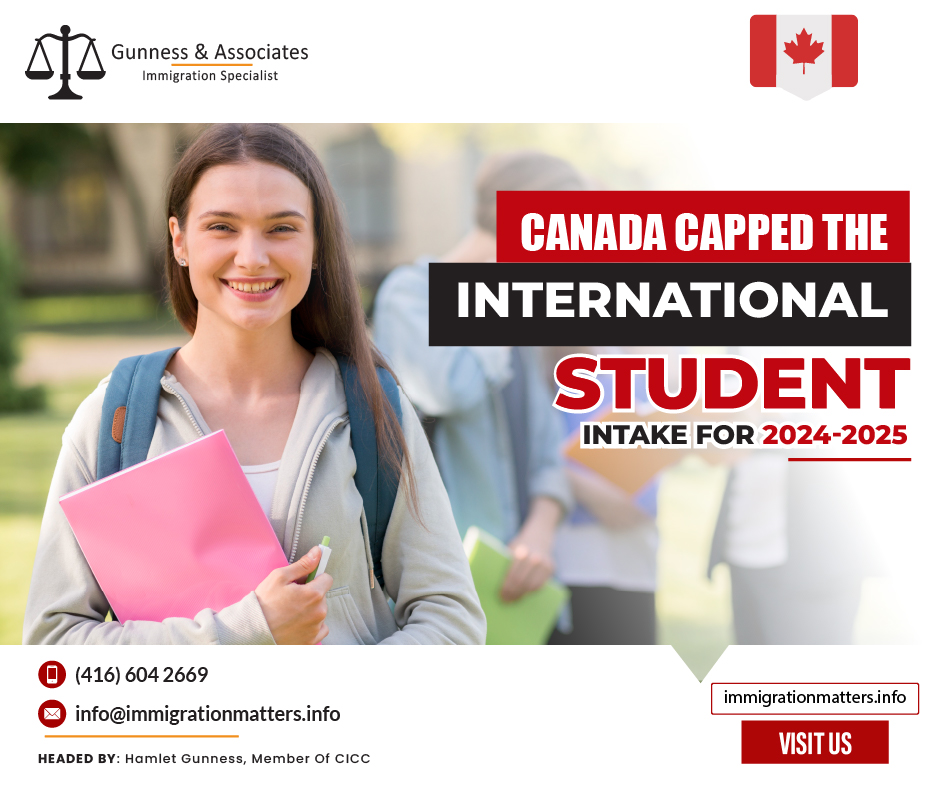
Canada capped the international student intake for 2024-2025

On January 22, 2024, Canada’s Minister of Immigration, Refugees and Citizenship Canada (IRCC), Marc Miller, announced a two-year cap on intake for 2024-2025 international student permit applications to stabilize growth. For 2024, the cap will result in around 360,000 approved permits, a 35% decrease from 2023. These measures do not apply to master’s, doctoral, elementary, and secondary education students and current permit holders.  Changes to the Post-Graduation Work Permit Program will start from September 1, 2024, affecting students’ curriculum licensing arrangements. Graduates of master’s and other short graduate programs will be eligible for a 3-year work permit. Open work permits will only be available to spouses of master’s and doctoral students. “International students bring significantly to Canada and enrich our communities. As a result, we have a responsibility to ensure that they have access to the resources they require for a fulfilling academic experience. This is not always the case in Canada today, according to Marc Miller, Minister of Immigration, Refugees, and Citizenship. “Today, we are announcing additional safeguards to protect a system that has grown so profitable that it has created a path for abuse. Enough is enough. Through the decisive measures announced today, we are striking the right balance for Canada, ensuring the integrity of our immigration system, and preparing students for the success they look for,” Miller added. Updates to the International Student Program focus on enhancing student protection Canada cherishes the social, cultural, and economic contributions of international students. To maintain these benefits and ensure student success, the Government of Canada addresses issues challenging the International Student Program’s integrity. This involves managing international student numbers sustainably and penalizing any threats to the system.  On October 27, 2023, Minister of Immigration, Refugees and Citizenship Canada (IRCC) Marc Miller introduced measures to strengthen Canada’s International Student Program and fight fraud. From December 1, 2023, post-secondary DLIs must confirm acceptance letters with IRCC for study permit applications. IRCC will reward DLIs offering superior services, including priority permit processing. Additionally, IRCC will adjust the Post-Graduation Work Permit Program to align with labor and immigration goals. Join our RSS Feed    If you want to know more details about the “Canada capped the international student intake for 2024-2025″ you can contact one of our immigration specialists at  Gunness & Associates.   Tel: (416) 604-2669  Email: info@test.immigrationmatters.info   Gunness & Associates has helped thousands of people successfully immigrate to Canada with their families. Our skilled and experienced immigration experts have the expertise to accurately examine your case and advise you on the best method of proceeding to serve your needs.   For honest and straightforward advice, contact the experts at Gunness & Associates Get a free Assessment  Join our newsletter and get up-to-date immigration news Click here All rights reserved ©2023 Gunness & Associates

international student program

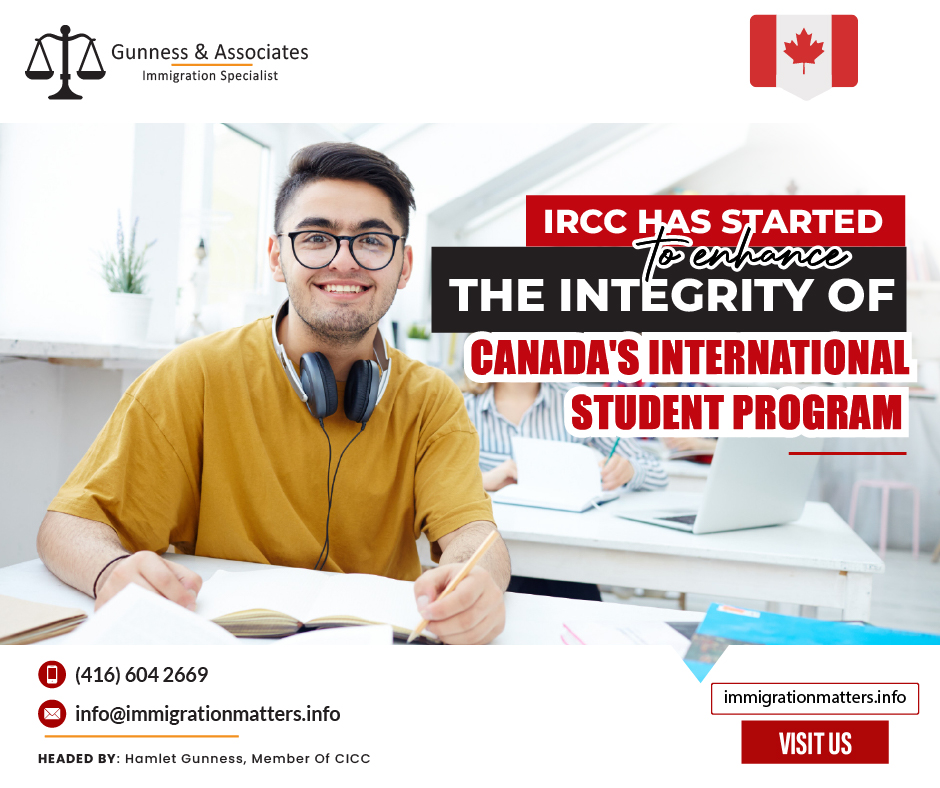
IRCC had started to enhance the integrity of Canada’s International Student Program

Immigration Refugees and Citizenship Canada (IRCC) began implementing steps to improve the credibility of Canada’s international student program. The government verifies international students’ acceptance letters through an online portal for Designated Learning Institutions (DLIs). Institutions have ten days for verification, the failure of which will cause the student visa application to be canceled. This change was prompted by past abuses of Canada’s international student systems.  A proposed “Trusted Institutions Framework” will introduce a two-tiered system for issuing study permits and may limit the number of student visas for better academic support. Other 2024 changes include:  increasing the cost-of-living requirement,  reconsidering the work cap, ending the measure allowing time spent abroad towards the Post-Graduation Work Permit (PGWP), and  aligning international student enrolment and PGWP issuance with labor market and demographic needs. We encourage potential international students to check their eligibility to ensure they meet all stream requirements and apply for the updated requirements and scoring. Canada acknowledges the significant social, cultural, and economic benefits that international students bring to the country, and for those benefits to continue, IRCC must address challenges to the program’s integrity. Taking action against nefarious actors who have preyed on genuine students for financial gain through these measures, identifying every fraudulent letter of acceptance soon after it is submitted.  Institutions that show strong support for international students will be recognized, and their applicants will be moved to the front of the processing line, allowing IRCC to better select and retain students who are best suited to meet the needs of Canada’s economy and immigration goals. What are the new changes to the Post-Graduation Work Permit (PGWP) and what is it? If you recently graduated from a designated learning institution (DLI) and would like to work temporarily in Canada, you may be eligible for a post-graduation work permit (PGWP). PGWPs are a great way to gain valuable work experience in Canada and are valid for eight months to three years. Having work experience in Canada opens up a lot of possibilities for an applicant looking for permanent residence in Canada.  The International Student Program has improved its Letter of Acceptance verification system and reviewed the Post-Graduation Work Permit program. International students in Canada hope for a PGWP extension in 2024, given the limited options for permanent residency. By mid-2023, Canada had approximately 2.2 million temporary residents, with over 1 million holding work permits – which has almost doubled in a year.  Join our RSS Feed    If you want to know more details about the “IRCC had started to enhance the integrity of Canada’s international student program” you can contact one of our immigration specialists at  Gunness & Associates.   Tel: (416) 604-2669  Email: info@test.immigrationmatters.info   Gunness & Associates has helped thousands of people successfully immigrate to Canada with their families. Our skilled and experienced immigration experts have the expertise to accurately examine your case and advise you on the best method of proceeding to serve your needs.   For honest and straightforward advice, contact the experts at Gunness & Associates Get a free Assessment  Join our newsletter and get up-to-date immigration news Click here All rights reserved ©2023 Gunness & Associates