Study in Canada

Germany

Canada and Germany are the leading countries for the immigration of international students

Canada and Germany are the leading countries for the immigration of international students The top two nations for foreign student immigration are Canada and Germany. Compared to other Organization for Economic Co-operation and Development (OECD) nations, Canada and Germany have the highest rates of immigration for foreign students.  Nearly all of the 38 countries that make up the OECD have policies in place to retain foreign students after they graduate, according to its International Migration Outlook 2022. With the exception of Germany, none of these other nations have had as much success retaining graduates with international educations as Canada.    The study found that more than 60% of foreign students who arrived in Canada and Germany in 2015 for academic reasons were still living there five years later.   The Organization for Economic Co-operation and Development (OECD)  Governments from 37 democracies with market-based economies work together in the Organization for Economic Co-operation and Development (OECD) to create guidelines for public policy that will support long-term economic growth. The OECD offers a platform where states may exchange ideas, look for solutions to shared problems, pinpoint best practices, and establish rigorous criteria for economic policy. The OECD has been a trustworthy source of fact-based policy analysis and economic data for more than 50 years. The United States is cooperating with other members to improve the OECD’s accountability, financial restraint, transparency, and responsiveness to member objectives.   OECD Member countries 20 countries originally ratified the Agreement on the Organization for Economic Co-operation and Development on December 14, 1960. Since then, the Organization has added 18 more members. There total of 38 member countries in OECD   Canada joined the OECD on April 10, 1961, and Germany on 27 September 1961   The table has details of OECD member countries Country  Date Country  Date AUSTRIA 29 September 1961 AUSTRALIA 7 June 1971 BELGIUM 13 September 1961 CANADA 10 April 1961 CHILE 7 May 2010 COLOMBIA 28 April 2020 COSTA RICA 25 May 2021 CZECH REPUBLIC 21 December 1995 DENMARK 30 May 1961 ESTONIA 9 December 2010 FINLAND 28 January 1969 FRANCE 7 August 1961 GERMANY 27 September 1961 GREECE 27 September 1961 HUNGARY 7 May 1996 ICELAND 5 June 1961 IRELAND 17 August 1961 ISRAEL 7 September 2010 ITALY 29 March 1962 JAPAN 28 April 1964 KOREA 12 December 1996 LATVIA 1 July 2016 LITHUANIA 5 July 2018 LUXEMBOURG 7 December 1961 MEXICO 18 May 1994 NETHERLANDS 13 November 1961 NEW ZEALAND 29 May 1973 NORWAY 4 July 1961 POLAND 22 November 1996 PORTUGAL 4 August 1961 SLOVAK REPUBLIC 14 December 2000 SLOVENIA 21 July 2010 SPAIN 3 August 1961 SWEDEN 28 September 1961 UNITED KINGDOM 2 May 1961 UNITED STATES 12 April 1961 SWITZERLAND 28 September 1961 TURKEY 2 August 1961   So far Canada and Germany are the top two countries in the OECD list that are the leading countries for the immigration of international students.   To find out more details about “the immigration of international students”, you can contact one of our immigration specialists at  Gunness & Associates.   Tel: (416) 604-2669  Email: info@test.immigrationmatters.info    Gunness & Associates has helped thousands of people successfully immigrate to Canada with their families. Our skilled and experienced immigration experts have the expertise to accurately examine your case and advise you on the best method of proceeding to best serve your needs.   For honest and straightforward advice, contact the experts at Gunness & Associates. Get a free Assessment  Join our newsletter and get up-to-date immigration news Click here All rights reserved ©2022 Gunness & Associate

IRCC

IRCC is Committed to Attracting and Retaining International Students

IRCC is Committed to Attracting and Retaining International Students The Canadian House of Commons Standing Committee on Citizenship and Immigration’s (CIMM) report outlines measures for the attraction, recruitment, and retention of international students in Canada. Immigration Refugees and Citizenship Canada (IRCC) recently released their official response to the report.   In order to address the unfavorable and precarious circumstances that international students encounter in Canada, CIMM previously issued IRCC a paper titled “Differential Treatment in Recruitment and Acceptance Rates of Foreign Students in Quebec and in the Rest of Canada.” The IRCC response addresses existing measures and makes fresh recommendations to lessen vulnerabilities, assisting foreign students with their application, academic program, and settling in Canada.   Regarding foreign students, the report focused on three primary goals: attracting foreign students to Canada to study; the International Student Program’s fairness; and enhancing communication and customer service for international students during the immigration and study permit processes.   The IRCC’s response highlighted steps that may be taken and are already in place to help with these three goals, covering each one separately in an effort to decrease vulnerabilities and support international students when they apply for study permits, enroll in courses, and settle in Canada.   Attracting International Students   The government has acknowledged that, between 2022 and 2023, there will be an estimated 753,000 international students with study permits, while also acknowledging the ICMM’s concern that, despite the increases, applications from some populations and countries are not given enough load by the department.   In return, IRCC agreed to: Examining the possibility of expanding the Student Direct Stream (SDS) to particular Francophone, Asian, and African nations. For applicants from 14 countries, the SDS is an expedited stream for obtaining a study permit; the Ministry of Immigration, Francisation and Integration (MIFI) and the Immigration and Refugee Council (IRCC) should create a working group to look into the rates of study permit refusal (generally, and for French-speaking African students in particular) headed for Quebec; maintaining and reconsidering the scope of the Nigeria Student Express (NSE) study permit stream, which was created to assist students applying from Nigeria; and Examine the best ways to encourage international students, especially those with the qualifications, experience, and language proficiency required for success in   Ensuring Equity in the Program for International Students   In their initial report to IRCC, the CIMM suggested a number of areas where potential actions to improve equity in the foreign student program and application processes may be taken. As a result, IRCC has promised to evaluate procedures and guarantee equity across the International Student Program (ISP) by   continuing to ask about accessibility, ethnicity, and gender in the yearly voluntary client experience survey to find out more about the particular problems that clients face based on their demographics; Create a framework for disaggregated data and analytics (DDAF). Disaggregated data is data that has been filtered to better understand the specific connections it has based on characteristics; for instance, to better understand how a certain set of individuals is impacted by a certain policy or phenomenon; examining the patterns and factors that affect social well-being among immigration generations with a focus on racial diversity; Review the procedure for choosing international students, and judge students according to standards that are more in line with their prospective value; and strengthening communication and customer service   Improving Interactions with Overseas Students   Most CIMM recommendations emphasized the value of providing clients and stakeholders with accurate information, especially about processing times and grounds for rejection. The IRCC has addressed these concerns by:   to increase processing efficiency and to make monthly backlog data available. Additionally, 1,250 additional processing workers will be employed by the end of 2022. The IRCC has committed to working with Designated Learning Institutions (DLIs) to collect information on the enrollment and status of international students. The DLIs instantly send the IRCC the data pieces. In order to promote transparency and understanding, the government expressed a desire to maintain initiatives like the 2022 pilot program, which required immigration officers to release their decision notes along with a select group of temporary residence visa (TRV) applicants early in the decision-making process.   To find out more details about the “IRCC commitment to attracting and retaining international students”, you can contact one of our immigration specialists at  Gunness & Associates.   Tel: (416) 604-2669  Email: info@test.immigrationmatters.info    Gunness & Associates has helped thousands of people successfully immigrate to Canada with their families. Our skilled and experienced immigration experts have the expertise to accurately examine your case and advise you on the best method of proceeding to best serve your needs.   For honest and straightforward advice, contact the experts at Gunness & Associates. Get a free Assessment  Join our newsletter and get up-to-date immigration news Click here All rights reserved ©2022 Gunness & Associate

The University of Toronto

The University of Toronto ranked as the best educational institution in Canada

The University of Toronto is one of the top 20 universities in the world and one of the top two public universities in Canada. According to the respected Times Higher Education World University Rankings.   Maclean’s news magazine has named the University of Toronto, which regularly places near the top of worldwide rankings of the world’s best educational institutions, Canada’s best university. The University of Waterloo came in second place, followed by the University of British Columbia in third. The magazine also broke down the results by subcategories, such as “the best quality of education.” Concerning that category, McGill topped the pack, followed by the University of Toronto and the University of Waterloo.   The University of Toronto The University of Toronto (U of T), one of the top universities in the world, was established in 1827. U of T is a destination for top talent, a hub for ideas and innovation, and a beacon of excellence and inclusivity because it is located in the city with the most diversity in the world.   The tri-campus system is well known throughout the world for its legacy of ground-breaking research and cutting-edge instruction that offers students a thorough global education and a transformative academic experience. The Times Higher Education World Reputation Rankings have ranked us among the top 20 universities in the world for the third year in a row, making us the top Canadian university.   Ideas, innovations, and talent from the University of Toronto have influenced worldwide discourse and produced significant change for nearly 200 years. The discovery of insulin, stem cells, deep learning, and neural networks are just a few examples of how research in the humanities, sciences and social sciences has improved millions of people’s lives worldwide and inspired new fields of study and companies.   The University of Toronto continues to foster social progress both domestically and internationally.   The University of Toronto Data Total number of students  75,821      Number of international students 18,631 Total number of academic staff  2,972      Number of international staff  1,060 Number of undergraduate degrees awarded  12,248 Number of master’s degrees awarded  5,826    Number of research-only staff 2,682 Number of doctoral degrees awarded  1,767     Number of new master’s students  5,789 Number of new undergraduate students  13,297    Number of new doctoral students  1,837   According to U of T President Meric Gertler,  “The University of Toronto is consistently ranked as one of the top universities in the world.” Scholars and researchers at the University of Toronto are increasing knowledge and understanding in a variety of subjects while addressing today’s most urgent global concerns.   Six weighted indicators of academic and research performance make up the Academic Ranking of World Universities. The number of alumni and faculty members who have received Fields Medals and Nobel Prizes, the number of researchers who have received multiple publications across 21 different subject areas, the number of papers published in the distinguished journals Nature and Science, the number of articles included in important citation indices, and the academic performance of each institution per student are among these metrics.   To find out more details about “the best educational institutions in Canada”, you can contact one of our immigration specialists at  Gunness & Associates.   Tel: (416) 604-2669  Email: info@test.immigrationmatters.info    Gunness & Associates has helped thousands of people successfully immigrate to Canada with their families. Our skilled and experienced immigration experts have the expertise to accurately examine your case and advise you on the best method of proceeding to best serve your needs.   For honest and straightforward advice, contact the experts at Gunness & Associates. Get a free Assessment  Join our newsletter and get up-to-date immigration news Click here All rights reserved ©2022 Gunness & Associate  

Atlantic International Graduate Program Canada AIGP Immigration

Atlantic International Graduate Program Canada AIGP Immigration

The Atlantic International Graduate Program (AIGP) is part of the AIPP. It is the program that helps employers hire qualified applicants for jobs they haven’t been able to fill locally.  The is a special immigration pathway for international graduates of eligible educational institutions in Atlantic Canada. It is aimed at candidates who have a degree, diploma, or another credential from a publicly-funded institution in an Atlantic province through Atlantic International Graduate Program. The Atlantic International Graduate Program Canada allows an opportunity for eligible foreign workers with a job offer from an employer in Atlantic Canada to submit an application for Canadian permanent residence.  Get a free Assessment Main Requirements for the Atlantic International Graduate Program The primary requirements for Atlantic International Graduate Program are given below: Job Offer Proof of Funds Work Experience Language Ability Education in Atlantic Canada NOC level job offer and qualifying work experience requirement NOC-level job offer Work experience requirement NOC 0 NOC 0, A, B, C NOC A NOC A, B, C NOC B NOC B, C NOC C NOC C Job Offer The job offer must meet all of these requirements following: The job offer must be consistent and regularly scheduled paid employment throughout the year. For NOC 0, A, or B skill type or level job offers, the employer must be offering you a job that will last at least 1 year For NOC C skill-level job offers, there is no set end date. The job offer cannot come from a company where the applicant is a majority owner. The job offer must be at the same skill level as, or higher than, the work experience that qualified the candidates for the job unless you’re an international graduate from a recognized post-secondary institution in Atlantic Canada. For certain healthcare sector jobs, the applicants do not need to show qualifying work experience. Working experience in NOC 3233 (practical nurses) and NOC 3012 (registered nurses) can be used as qualifying work experience if the candidates have a job offer in NOC 3413 (nurse aides, orderlies, and patient service associates) or NOC 4412 (home health care workers). The job offer must be full-time. Language requirements You have to meet the minimum language requirements based on the NOC category that applies to your job offer: CLB (Canadian Language Benchmarks) or NCLC (Niveaux de compétence Linguistique Canadiens) The minimum language requirements for each NOC category are CLB/NCLC 5 for NOC 0, A, and B CLB/NCLC 4 for NOC C Join our newsletter and get up-to-date immigration news Click here. Proof of Funds Applicants need to show they have enough money to support themselves and their families after immigrating to Canada. The Candidate’s funds depend on the size of the family and include family members a candidate supports that are not immigrating.  The required settlement funds have to be equal to or greater than the sums listed below for each family size. Number of family members Funds required In-CAD 1 $3,327 2 $4,142 3 $5,092 4 $6,183 5 $7,013 6 $7,909 7 $8,806 For each additional family member $896 Who may use this application? You may apply through the Atlantic International Graduate Program if you meet the eligibility requirements and plan to settle permanently in one of the following Canadian Atlantic destination provinces: New Brunswick Newfoundland and Labrador Nova Scotia Prince Edward Island Educational requirements for the Canada AIGP Program The Educational requirements for the Canada Atlantic International Graduate Program, you must have one of these- If you:  studied outside Canada, you need an educational credential assessment (ECA) to confirm that your studies are equal to or higher than the required level of education for your job offer. have a job offer at the NOC 0 or A skill type or level, you must have a Canadian one-year post-secondary educational credential or higher, or the equivalent outside Canada. have a job offer at the NOC B or C skill level, you must have a Canadian high school diploma or the equivalent outside Canada. Your ECA report has to be less than 5 years old on the date IRCC receives your application. To know more details about the application process for the Canadian Atlantic International Graduate Program, you can contact one of our immigration specialists at Gunness & Associates. Tel: (416) 604-2669 Email: info@test.immigrationmatters.info All rights reserved ©2022 Gunness & Associate
List of the Top 50 Universities in Canada 2022

List of the Top 50 Universities in Canada 2022

These top 50 universities in Canada have been numerically ranked based on their positions in the overall best performance. For example, universities were evaluated based on their academic and employer reputations, research performance, and their ratings by members of the academic community around the country. The top 50 universities in Canada are the following: 1. University of Toronto The University of Toronto is Canada’s top university with a long history of challenging the impossible and transforming society through the ingenuity and resolve of its faculty, students, alumni, and supporters. The University of Toronto is a leading university, not only in Canada but also across the world. It is ranked 18th as the best university globally. It was established in 1827. The University of Toronto is the number one Canadian university on the list of top universities in Canada. Get a free Assessment 2. University of British Columbia    The University of British Columbia was established in 1908. It is a public institution located in the Canadian province of British Columbia. It is not only ranked in Canada but also ranked on the globe as 35th. The total number of students is 56,921 among them international students are 19,262.  3. McGill University McGill University is one of the top-notch public institutions that was founded in 1821 and is located in Quebec, Canada. McGill University is ranked #51 in Best Global Universities. 4. McMaster University The University of McMaster University was founded in 1887, it is ranked in the world’s Top 75 by the Times Higher Education (THE) World University Rankings. It has six main academic divisions –  engineering health sciences humanities science social sciences and  the DeGroote School of Business  5. University of Alberta The University of Alberta is ranked #135 in Best Global Universities by US News. It is one of the top teaching and research universities in Canada, with an international reputation for excellence across the humanities, sciences, creative arts, business, engineering, and health sciences. The University of Alberta is ranked 5 among the list of top 50 universities in Canada. It was founded in 1908. And some other top Canadian Universities are given: 6.              Simon Fraser University 7.              York University Toronto 8.              University of Calgary 9.              University of Waterloo  10.          Université de Montréal 11.          Western University   12.          University of Victoria   13.          Queen’s University    14.          Université Laval  15.          Toronto Metropolitan University 16.          University of Guelph 17.          Carleton University 18.          Dalhousie University 19.          University of Saskatchewan 20.          University of Ottawa 21.          Concordia University 22.          University of Manitoba 23.          Université du Québec à Montréal 24.          Memorial University of Newfoundland 25.          Université de Sherbrooke 26.          University of New Brunswick 27.          Brock University 28.          Wilfrid Laurier University 29.          University of Windsor 30.          University of Regina 31.          University of Lethbridge 32.          British Columbia Institute of Technology 33.          École Polytechnique de Montréal 34.          The University of Winnipeg 35.          Université du Québec à Chicoutimi 36.          HEC Montreal 37.          Université du Québec 38.          Trent University 39.          Acadia University 40.          Lakehead University 41.          École de Technologie Supérieure 42.          Vancouver Island University 43.          Ontario Tech University     44.          University of Northern British Columbia 45.          Kwantlen Polytechnic University 46.          University of Prince Edward Island 47.          Thompson Rivers University 48.          Saint Mary’s University 49.          OCAD University 50.          Laurentian University Join our newsletter and get up-to-date immigration news Click here. Why Choose Canada to Study? We have given a list of the top 50 universities in Canada. There are not only the best universities in Canada but also the leading universities around the world. Canada is one of the world’s most developed countries and it’s able to provide its citizens with a high standard of education.  The country is one of the most popular destinations for Canadian or international students. There are also numerous scholarships and other educational aids made available to students, making Canada one of the best places to study in the world. To know more details about the top 50 universities in Canada, you can contact one of our immigration specialists at Gunness & Associates. Tel: (416) 604-2669 Email: info@test.immigrationmatters.info All rights reserved ©2022 Gunness & Associate

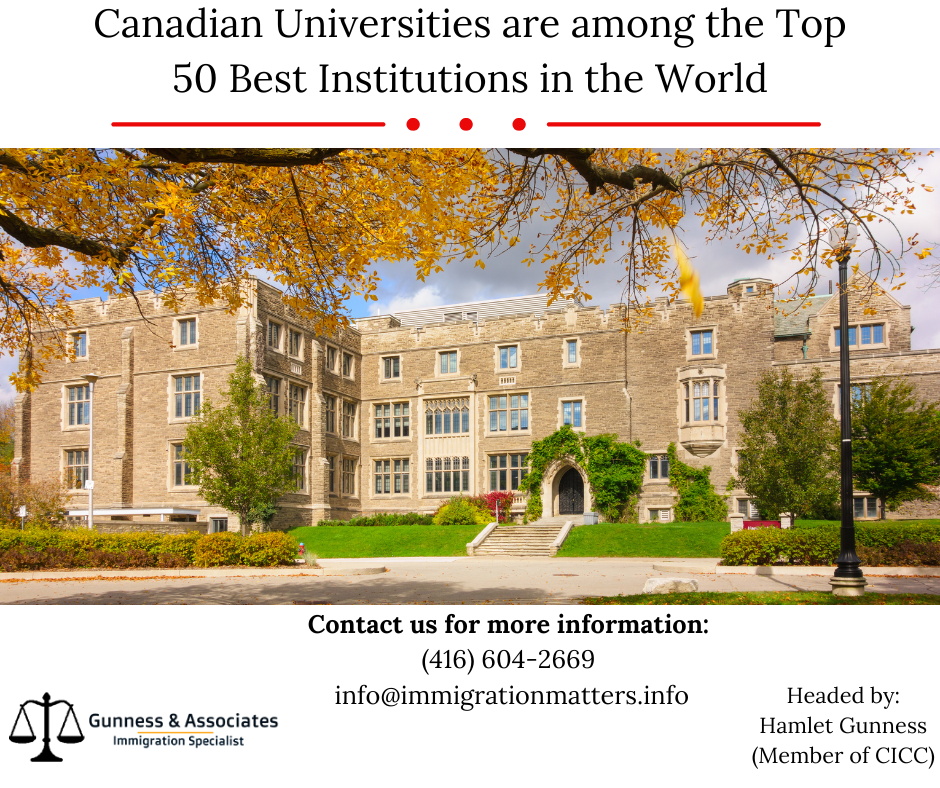
Canadian Universities are among the Top 50 Best Institutions in the World

Canadian Universities are among the Top 50 Best Institutions in the World

The latest ranking by QS Quacquarelli Symonds, a provider of analytics and insight to the worldwide higher education sector, includes three Canadian Universities among the top 50 in the world. According to the organization’s annual QS Top Universities ranking, McGill University, the University of Toronto, and the University of British Columbia made it into the top 50 best colleges in the world.  Another eleven Canadian institutions appeared in the top 25% of more than 1,400 universities ranked by Quacquarelli Symonds in its list, further demonstrating the strength of Canada’s university education system. The Three Canadian Universities in the World’s Top 50 Three Canadian universities are named among the top 50 in the world in the latest ranking by Quacquarelli Symonds, to the global higher education sector. They are: McGill University The University of Toronto The University of British Columbia QS World University Rankings is the largest ever, with over 1,400 institutions across 100 locations, up from 1,300 last year. McGill University has been named Canada’s best university, according to the 19th edition of the QS World University Rankings, released by global higher education analysts QS Quacquarelli Symonds. The University was ranked 31st university in the world. It marks the first time in five years that McGill is Canada’s top-ranked university on the QS list. Its place in the rankings is underpinned by consistent performances across QS indicators. In Particular, it outperforms Canada’s other two top-ranking universities in terms of research. It comes 203rd globally in Citations per Faculty while UT and the University of British Columbia come 313th and 332nd. Quacquarelli Symonds Notes, “Based in Montreal, McGill University ranks among Canada’s most prestigious universities, attracting thousands of international students from over 150 countries every year, and the highest percentage of Ph.D. students of any Canadian research university.” “Graduates are highly sought after by employers, with the following percentages of graduates in education or employment two years after graduation: 81 percent of art graduates; 95 percent of engineering graduates; 91 percent of medicine graduates; 84 percent of science graduates, and; 92 percent of all Ph.D. respondents.” McGill ranked 27th on the list with an overall score of 81.9, narrowly beating out the University of Toronto for the bragging rights to the best university in Canada. Read also: the List of the Top 50 Universities in Canada 2022 University Of Toronto Named Second-Best Canadian University The University of Toronto ranked 34th with a score of 81.5. At the master’s level, UofT offers over 280 graduate programs in a wide variety of fields, including more than 60 professional graduate programs and 76 combined programs that include professional master’s components. The university has 40 collaborative programs and three diploma programs. The Third most The University of British Columbia Notes the report from Quacquarelli Symonds, “The University of British Columbia is recognized internationally for excellence in teaching and research as well as global impact. Since 1915, UBC has been opening doors of possibility for people with the curiosity, drive, and vision to shape a better world,” Remember that The University of British Columbia, the third most highly rated Canadian university on the list, placed 47th globally with a score of 77. Most of the approximately 350,000 foreign nationals who come to study at Canadian universities must apply for study permits. You are interested to come to Canada but do not know how it is processing? Or need help coming to Canada? Well, feel free to discuss the study permit with the Canadian Immigration Specialist at Gunness & Associates. Professionally we have been helping thousands of students to come to Canada. Get a free assessment to see if you are eligible to immigrate to Canada. Tel: (416) 604-2669 Email: info@test.immigrationmatters.info Join our free newsletter All rights reserved ©2022 Gunness & Associates