Uncategorized

Francophone immigration research

The Government of Canada supports research into Francophone immigration

On November 8, 2023, The Government of Canada supports research into Francophone immigration. The Minister of Immigration, Refugees and Citizenship Canada (IRCC), Marc Miller, announced an $85,000 grant for the Université de l’Ontario français to support the Observatoire en immigration francophone au Canada.  This initiative will establish an oversight committee to define the observatory’s mission and governance,  address Francophone immigration research concerns, and guide the Government of Canada’s efforts in this area.  A portion of the funds will go towards a survey on Francophone immigration research needs in Canada. This endeavor underscores Canada’s commitment to promoting Francophone immigration outside Quebec, enriching cultural and linguistic diversity, and bolstering local economies. The funding will enable the formation of an oversight committee composed of university and community representatives, which will assist key players in the Francophone immigration sector in their work. The mission, objectives, and governance model of the observatory will be defined and validated. The project will assess various groups’ concerns about Francophone immigration research.  This increased knowledge and understanding of the realities of Francophone immigration will allow the Canadian government to better direct its efforts in this area.  Newcomers who speak French contribute to our country’s cultural and linguistic diversity while also strengthening the economic systems of the communities where they settle. Canada is continuing to promote Francophone immigration outside of Quebec, which is a top priority for the coming years. The Honourable Marc Miller, Minister of Immigration, Refugees and Citizenship stated: “French immigration is critical to the vitality and growth of Francophone communities outside of Quebec.” The Observatoire en immigration francophone au Canada will help to promote the reception and integration of Francophone immigrants in Canada. The observatory is a great example of how community partners can help us achieve our ambitious goals for Francophone immigration and strengthening Francophone minority communities across the country.” Join our RSS Feed    Want to know more details about “The Government of Canada supports research into Francophone immigration” you can contact one of our immigration specialists at  Gunness & Associates.   Tel: (416) 604-2669  Email: info@test.immigrationmatters.info   Gunness & Associates has helped thousands of people successfully immigrate to Canada with their families. Our skilled and experienced immigration experts have the expertise to accurately examine your case and advise you on the best method of proceeding to best serve your needs.   For honest and straightforward advice, contact the experts at Gunness & Associates Get a free Assessment  Join our newsletter and get up-to-date immigration news Click here All rights reserved ©2023 Gunness & Associates
2024-2026 Immigration Levels Plan

IRCC announced the 2024-2026 Immigration Levels Plan Canada

On November 1, 2023, Immigration, Refugees and Citizenship Canada (IRCC) released Canada’s 2024-2026 Immigration Levels Plan. The new plan aims to welcome 485,000 newcomers in 2024 and 500,000 in 2025 and 2026.  According to the new plan, the Government plans:  to focus on economic growth, family reunification, and  humanitarian responses to immigration,  also increasing French-speaking permanent residents outside Quebec to 8% by 2026.  The 2024-2026 Immigration Levels Plan will focus on filling labor gaps in sectors like health, STEM, trades, transportation, and agriculture, supporting a green, digital economy, offering protection to those in need, and ensuring newcomers receive necessary support like housing and healthcare. Citizenship, Immigration, and Refugees Canada is pleased to provide information on the Government of Canada’s Immigration Levels Plan for the years 2024-2026. Following the trajectory of the 2023-2025 Plan, Canada intends to accept 485,000 new permanent residents in 2024, 500,000 in 2025, and 500,000 in 2026.  This plan prioritizes economic growth and family reunification, while also responding to humanitarian crisis and recognizing the recent surge in immigration. The Plan includes new annual and progressively increasing French-speaking permanent resident targets outside Quebec, based on the achievement of a 4.4% target of French-speaking permanent residents outside Quebec in 2022: 6% in 2024, 7% in 2025, and 8% in 2026. Overview of targets of the 2024-2026 Immigration Levels Plan Canada  The following table summarizes Canada’s immigration goals for the years 2024-2026: Immigration Class 2024 2025 2026 Economic 281,135 301,250 301,250 Family 114,000 118,000 118,000 Refugee 76,115 72,750 72,750 Humanitarian 13,750 8,000 8,000 Total 485,000 500,000 500,000 Express and PNP Targets for 2024-2026 Immigration Levels Plan Canada’s target for immigration levels in 2024–2026 is to support refugees, boost the economy, and bring families back together. Most permanent residents enter Canada through well-known economic-class immigration programs like the Provincial Nominee Programs (PNPs) and Canada Express Entry.  Express Entry Program 110,700 admissions in 2024 117,000 admissions in 2025 117,000 admissions in 2026 Provincial Nominee Programs (PNPs) 110,000 admissions in 2024 120,000 admissions in 2025 120,000 admissions in 2026 Spousal, Partner, and Children Sponsorship 82,000 admissions in 2024 84,000 admissions in 2025 84,000 admissions in 2026 Parents and Grandparents Program (PGP) 32,000 admissions in 2024 34,000 admissions in 2025 34,000 admissions in 2026 Join our RSS Feed    Want to know more details about the “IRCC announced the 2024-2026 Immigration Levels Plan Canada” you can contact one of our immigration specialists at  Gunness & Associates.   Tel: (416) 604-2669  Email: info@test.immigrationmatters.info   Gunness & Associates has helped thousands of people successfully immigrate to Canada with their families. Our skilled and experienced immigration experts have the expertise to accurately examine your case and advise you on the best method of proceeding to best serve your needs.   For honest and straightforward advice, contact the experts at Gunness & Associates Get a free Assessment  Join our newsletter and get up-to-date immigration news Click here All rights reserved ©2023 Gunness & Associates

immigration system of Canada

The Immigration Minister announced new measures to strengthen immigration system of Canada

On October 31, 2023, Immigration Minister Marc Miller presented the report “An Immigration System for Canada’s Future.” This report outlines plans to bolster the immigration system of Canada to support economic growth and keep Canada appealing.  Details of an Immigration System for Canada’s Future The Honourable An Immigration System for Canada’s Future, a report laying out a pathway to strengthen our immigration system for people, ensure immigration continues to contribute to Canada’s economic growth and help businesses and communities thrive, was released today by Marc Miller, Minister of Immigration, Refugees, and Citizenship. To maintain our status as a strong multicultural country and a popular destination, our future immigration system must be agile and responsive to the needs of both our country and newcomers. The report identifies actions to transform Canada’s immigration system that have been informed by meetings with a diverse range of partners and stakeholders. Some changes are already in effect, while others are in progress. The report suggests several enhancements, such as: Positioning the immigration system to respond quickly, equitably, and sustainably to growing global humanitarian crises. Creating a new Francophone Immigration Policy to boost the vitality of Francophone minority communities while maintaining and boosting the demographic weight of French linguistic minority communities in Canada. Improving the International Student Program by collaborating with provinces and territories on a Recognized Institutions Framework so that post-secondary institutions with high standards in key areas such as integrity and student support can benefit from faster study permit processing. Housing, health care, and infrastructure planning, as well as other essential amenities, are being incorporated into Canada’s immigration levels planning in close collaboration with provinces, territories, and municipalities. Creating an advisory body of newcomers with immigration experience to help inform program and policy improvements, as well as service delivery. creating a Chief International Talent Officer position to more effectively align immigration programs and pathways with the labor market, including industry and sector strategies. Making our website more user-friendly so that applicants can easily find the information they need. These actions can assist in the creation of a system that meets the needs of the Canadian economy and labor market. Changes will be implemented through cross-government collaboration and a focus on welcoming the people who will be needed in the future while maintaining the system’s safety, security, and integrity. Join our RSS Feed    Want to know more details about “The Immigration Minister announced new measures to strengthen Canada’s immigration system” you can contact one of our immigration specialists at  Gunness & Associates.   Tel: (416) 604-2669  Email: info@test.immigrationmatters.info   Gunness & Associates has helped thousands of people successfully immigrate to Canada with their families. Our skilled and experienced immigration experts have the expertise to accurately examine your case and advise you on the best method of proceeding to best serve your needs.   For honest and straightforward advice, contact the experts at Gunness & Associates Get a free Assessment  Join our newsletter and get up-to-date immigration news Click here All rights reserved ©2023 Gunness & Associates
new measures to support Moroccan nationals

IRCC announces new measures to support Moroccan nationals

On October 26, 2023, the Government of Canada announced new measures to support Moroccan nationals so that Moroccan nationals in Canada can extend their study, work, or family visit status without charge, effective October 19, 2023.  These special measures apply to those in Canada as of September 8, when the earthquake occurred, and are designed to facilitate the extension of temporary status or transitioning between temporary streams. The measures will remain in effect until March 12, 2024.  Immigration, Refugees and Citizenship Canada (IRCC) has prioritized processing temporary and permanent residence applications received on or before September 8, 2023, from people affected by the earthquake. Details of the new measures to support Moroccan nationals As part of Canada’s response to the situation in Morocco, Immigration, Refugees, and Citizenship Canada has prioritized temporary and permanent residence applications from people affected by the devastating earthquake received on or before September 8, 2023. This includes visitor visa applications for immediate family members of Canadian citizens and permanent residents, as well as existing refugee resettlement applications. The Canadian government is now taking steps to make it easier for Moroccan nationals who are already in Canada to extend their stay. Canada updates the instructions for biometrics collection Recognizing that some people may have lost their travel documents as a result of the earthquake, IRCC will waive the requirement that applicants hold a passport or travel document in order to be approved for a permanent resident visa to enter Canada. We are also making it easier for Moroccan Canadian citizens and permanent residents to return to Canada by waiving fees for temporary passports, limited-validity passports, and emergency travel documents, as well as Canadian citizenship certificates and permanent resident travel documents. These measures will be in effect from October 19, 2023, to March 12, 2024. Join our RSS Feed    Want to know more details about “IRCC announces new measures to support Moroccan nationals” you can contact one of our immigration specialists at  Gunness & Associates.   Tel: (416) 604-2669  Email: info@test.immigrationmatters.info   Gunness & Associates has helped thousands of people successfully immigrate to Canada with their families. Our skilled and experienced immigration experts have the expertise to accurately examine your case and advise you on the best method of proceeding to best serve your needs.   For honest and straightforward advice, contact the experts at Gunness & Associates Get a free Assessment  Join our newsletter and get up-to-date immigration news Click here All rights reserved ©2023 Gunness & Associates
Rural and Northern Immigration Pilot Progra

Sudbury considered new applications in the Rural and Northern Immigration Pilot Program

On October 13, 2023, the City of Greater Sudbury held a new round of invitations for the Rural and Northern Immigration Pilot Program. In this round, Sudbury considered 33 candidates, including two candidates drawn through the Francophone Stream.  The lowest score of these draws was 235 points, five points lower than in the previous draw.  Last year, Sudbury invited a total of 154 applicants. Since the program’s launch, the city has recommended around 520 individuals under the RNIP. So far, the city has considered 412 candidates in 2023. About the Rural and Northern Immigration Pilot Program The Rural and Northern Immigration Pilot is an initiative driven by the local communities. By offering a path to permanent residency for highly talented foreign workers who wish to live and work in one of the participating communities, it aims to expand the benefits of economic immigration to smaller communities. Additionally, each community will have its own: additional criteria for being eligible process for applying for jobs community recommendations application process Participating communities in RNIP are: North Bay, ON Sudbury, ON Timmins, ON Sault Ste. Marie, ON Thunder Bay, ON Brandon, MB Altona/Rhineland, MB Moose Jaw, SK Claresholm, AB Vernon, BC West Kootenay (Trail, Castlegar, Rossland, Nelson), BC Join our RSS Feed    Want to know more details about “The City of Sudbury considered new applications under the Rural and Northern Immigration Pilot Program” you can contact one of our immigration specialists at  Gunness & Associates.   Tel: (416) 604-2669  Email: info@test.immigrationmatters.info   Gunness & Associates has helped thousands of people successfully immigrate to Canada with their families. Our skilled and experienced immigration experts have the expertise to accurately examine your case and advise you on the best method of proceeding to best serve your needs.   For honest and straightforward advice, contact the experts at Gunness & Associates Get a free Assessment  Join our newsletter and get up-to-date immigration news Click here All rights reserved ©2023 Gunness & Associates

processing times

Processing times for LMIA applications are updated

On October 6, 2023, Employment and Social Development Canada (ESDC) updated the processing times for the Labour Market Impact Assessment (LMIA) applications under various streams.  Updated LMIA application Processing times are: Based on statistics from all processing centers, the current average LMIA application processing times have increased only for the Low-wage Stream.  Global Talent Stream – 9 business days Agricultural stream – 11 business days (-1 day) Seasonal Agricultural Worker Program – 6 business days (-3 days) Permanent residence Stream – 58 business days (-5 days) In-home caregivers – 25 business days (-5 days) High wage Stream – 40 business days Low-wage Stream – 45 business days (+1 day) If you’re an employer and looking to get an LMIA or hire a foreign skilled worker for your business get an assessment with Gunness & Associates About the Labour Market Impact Assessment (LMIA) Before hiring a foreign worker, a Canadian business may be required to get a Labour Market Impact Assessment (LMIA). A positive LMIA will demonstrate that a foreign worker is required to fill the position. Additionally, it will demonstrate that no Canadian citizen or permanent resident is qualified for the position. A confirmation letter is another name for a positive LMIA. The worker can submit a work permit application after the employer receives the LMIA.   Applicants for work permits must meet the following requirements: a job offer letter,  a contract,  a copy of the LMIA, and  the LMIA number Labour Market Impact Assessment (LMIA) process with ESDC Employment and Social Development Canada (ESDC) determines whether hiring a foreign national will have a positive or neutral impact on the Canadian labor market. The effect of the specific occupation designated by the employer on the labor market is the subject of assessment by ESDC, not whether the foreign national meets the occupational requirements. Based on the information provided by the employer, the ESDC officer determines the appropriate NOC code while reviewing the LMIA application. Join our RSS Feed    Want to know more details about “Processing times for LMIA applications are updated” you can contact one of our immigration specialists at  Gunness & Associates. Tel: (416) 604-2669  Email: info@test.immigrationmatters.info   Gunness & Associates has helped thousands of people successfully immigrate to Canada with their families. Our skilled and experienced immigration experts have the expertise to accurately examine your case and advise you on the best method of proceeding to best serve your needs. For honest and straightforward advice, contact the experts at Gunness & Associates Get a free Assessment Join our newsletter and get up-to-date immigration news Click here All rights reserved ©2023 Gunness & Associates
the Parents and Grandparents Program

Canada started inviting candidates under the Parents and Grandparents Program

On October 10, 2023, the Canadian Government started inviting candidates through the Parents and Grandparents Program (PGP). From October 10 to October 23, Immigration, Refugees and Citizenship Canada (IRCC) will send invitations to apply to 24,200 potential sponsors selected randomly from the pool of submissions from 2020.  IRCC aims to receive 15,000 complete applications. Candidates who submitted an interest to sponsor form in 2020 but have yet to receive an invitation to apply for the PGP in 2021 or 2022 should continue checking their emails for the invitation from IRCC. The Government has also updated the income requirements that all applicants must follow to be considered eligible. If you have got an invitation to PGP 2023, get a free legal consultation. What are the updated income requirements for the Parents and Grandparents Program? You, the sponsor (and your co-signer, if you have one), must demonstrate that you have sufficient money to support all of the persons for whom you will be financially responsible after you become a sponsor. You are included in this. If you are asked to apply, you must show proof that you have met the income requirements for each of the three tax years before the date you apply. The table below shows that the income is required for the three tax years preceding the day you apply (sponsors applying in 2023). Total number of people  2022 2021 2020 2 people $43,082 $32,898 $32,270 3 people $52,965 $40,444 $39,672 4 people $64,306 $49,106 $48,167 5 people $72,935 $55,694 $54,630 6 people $82,259 $62,814 $61,613 7 people $91,582 $69,934 $68,598 If more than 7 people, for each additional person, add: $9,324 $7,120 $6,985 What are the Parents and Grandparents Program Eligibility Requirements? To be qualified to sponsor your family members for Canadian PR (Permanent Residency), such as parents or grandparents, you must be: at least 18 years old. A Canadian citizen, a Canadian permanent resident, or a person who is registered as an Indian in Canada under the Canadian Indian Act. Have sufficient funds to assist the family you decide to sponsor. Also, provide acceptable evidence of income for the previous three years that meets the IRCC’s financial requirements. Join our RSS Feed    Want to know more details about “The Government of Canada started inviting candidates under the Parents and Grandparents Program” ” you can contact one of our immigration specialists at  Gunness & Associates.   Tel: (416) 604-2669  Email: info@test.immigrationmatters.info   Gunness & Associates has helped thousands of people successfully immigrate to Canada with their families. Our skilled and experienced immigration experts have the expertise to accurately examine your case and advise you on the best method of proceeding to best serve your needs.   For honest and straightforward advice, contact the experts at Gunness & Associates Get a free Assessment Join our newsletter and get up-to-date immigration news Click here All rights reserved ©2023 Gunness & Associates
wildfire

Canada extended measures for temporary and permanent residents affected by wildfires

On October 4, 2023, the Canadian Government extended temporary measures for communities affected by the 2023 wildfire. To be eligible for special measures, applications for document replacement, extension, or restoration must be submitted by November 30, 2023. On June 12, 2023, the Government announced free replacement documents for Canadians and residents who lost or damaged their documents due to the fires.  Temporary residents affected by the wildfires whose status was expiring by September 30, 2023, could extend or restore their status in Canada for free. Free replacement documents and special measures for Canadians affected by devastating wildfires With the country undergoing an unprecedented wildfire season, the Government of Canada is acting quickly to assist communities and residents. This includes assistance for Canadians as well as individuals who are critical to the rebuilding effort. The Honourable Sean Fraser, Minister of Immigration, Refugees, and Citizenship, announced special measures for those who have been affected and need to replace crucial documents or extend or restore their status in Canada. For Canadians, permanent residents, and temporary residents directly affected by the wildfires, Immigration, Refugees, and Citizenship Canada (IRCC) will provide free replacement documents. Permanent resident cards, Canadian citizenship certificates, Canadian passports, and other travel documents lost, damaged, destroyed, or made unusable as a result of wildfires are listed. International students, temporary foreign workers, and other visitors whose status in Canada will expire before September 30, 2023, will also be eligible to apply, reinstate, or extend their status in Canada for free. This means that temporary workers who are unable to work because their workplace has been closed due to the fires will be able to extend their status and stay until their workplace reopens. In addition, if their classes are postponed or canceled, overseas students can extend their study permits and complete their studies without penalty. The Honourable Sean Fraser, Minister of Immigration, Refugees and Citizenship stated: “We will continue to assist anyone affected by devastating wildfires across the country. These new measures will make it easier for Canadians, permanent residents, and temporary residents to replace misplaced documents. They will also assist in ensuring that temporary residents are not unfairly penalized and will be present to assist in the rebuilding of our communities. Thank you to all first responders and firefighters across the country for your ongoing courage and hard work in protecting our communities during this difficult time.”  Join our RSS Feed    Want to know more details about “Canada extended measures for temporary and permanent residents affected by wildfires” you can contact one of our immigration specialists at  Gunness & Associates.   Tel: (416) 604-2669  Email: info@test.immigrationmatters.info   Gunness & Associates has helped thousands of people successfully immigrate to Canada with their families. Our skilled and experienced immigration experts have the expertise to accurately examine your case and advise you on the best method of proceeding to best serve your needs.   For honest and straightforward advice, contact the experts at Gunness & Associates Get a free Assessment Join our newsletter and get up-to-date immigration news Click here All rights reserved ©2023 Gunness & Associates
Canadian immigrants

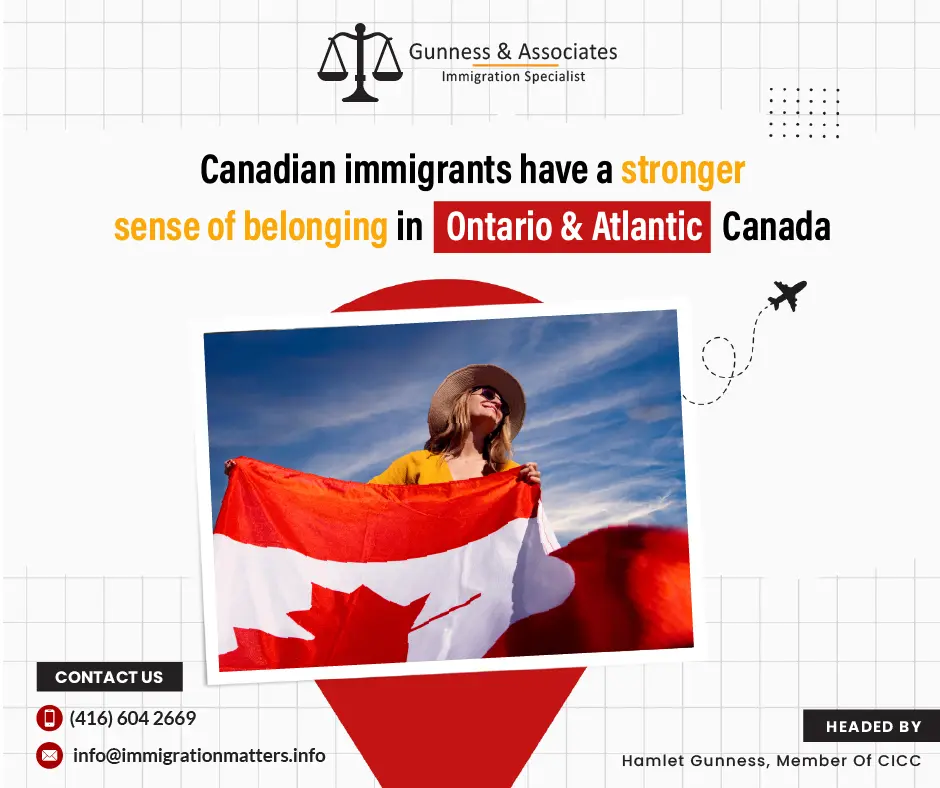
Canadian immigrants have a stronger sense of belonging in Ontario and Atlantic Canada

Sense of belonging to a country, especially as immigrants, has long been used to measure social integration and national identification in Canada. The 2020 General Social Survey (GSS) conducted by Statistics Canada provides insight into the provinces and territories where immigrants feel a strong sense of belonging.  According to the survey, immigrants in Ontario and the Atlantic-Canadian provinces (Nova Scotia, Prince Edward Island, Newfoundland and Labrador, and New Brunswick) reported a powerful sense of belonging to Canada. On the other hand, immigrants in British Columbia and Alberta reported a lower sense of belonging. What factors affect the sense of belonging of Canadian immigrants? In large part, post-migration experiences that give immigrants favorable feedback from their surroundings, such as whether they feel accepted in this country and whether they believe they have strong possibilities for success, influence how immigrants feel like they belong in Canada. The results of this survey also imply that the following other factors may have an effect on the “cross-provincial variation” in immigrants’ sense of belonging: Socio-Demographics of Immigrants Each Region’s Immigrant Composition Acceptance Feelings/Instances of Discrimination Context and structural factors Socio-Demographics of Immigrants The number of years since immigration, the person’s age at the time of immigration, their immigration admission category, and the population group they are emigrating into are sociodemographic characteristics that may affect an immigrant’s sense of belonging in Canada. The socio-demographic makeup of the immigrant population in each province varies as a result of long-term variations in immigrants’ patterns of settlement. These compositional changes may have an impact on the diversity in immigrants’ sense of belonging to Canada among provinces. Each Region’s Immigrant Composition “Immigrant composition” refers to a different set of factors that are in play. Recent immigrants make up a varied proportion of the total population in each Canadian province. According to a survey from 2021, for instance, “the share of recent immigrants ranged from 14% of immigrants in British Columbia and Ontario to 30% (or more) of immigrants residing in Saskatchewan and the Atlantic provinces.” According to this survey, a region’s immigrant population may have an impact on immigrants’ feelings of belonging in Canada because these feelings are typically “weaker among recent immigrants than among longer-term immigrants.” This suggests that immigrants’ sense of belonging to Canada grows over time, according to the survey’s authors. In light of this, the regional average for immigrants’ sense of belonging may be stronger in those provinces where they have lived for a long-term duration. Acceptance Feelings/Instances of Discrimination  Diverse opinions on inclusion and exclusion may result from the diversity of different ethnic groups within the immigrant population and their variance in size across different regions. The likelihood that an immigrant would have a strong sense of belonging in their selected province is significantly influenced by discrimination. While some immigrants experience exclusion, others are welcomed by their community. Context and structural factors When it comes to “structural factors,” such as employment, educational possibilities, economic diversity, etc., there are significant regional differences across Canada. Each of these has an impact on how newcomers integrate and acculturate.  Additionally, socioeconomic conditions are another name for structural factors in the territories and provinces.    The 2020 General Social Survey (GSS) results Last but not least, the information from StatsCan’s 2020 GSS shows some significant variation in the perceived sense of belonging among immigrants in Canada, which might be partly attributable to the factors mentioned above. The % “predicted probability of immigrants reporting a very strong sense of belonging to Canada by province of residence” is shown in the table below. Province  Percentage  Atlantic Canada  63.85 Ontario  63.19 Manitoba  58.89 Quebec  58.52 Alberta  55.85 Saskatchewan  53.79 British Columbia  52.77 In general, immigrants believe a high sense of belonging to Canada when living in Ontario and the Atlantic provinces (PEI, NS, NL, and NB), although this feeling was reduced among immigrants in British Columbia and Alberta. It’s interesting to note that the immigrant makeup of Alberta plays a significant role in the disparity between immigrants who live there and those who reside in Ontario in terms of their sense of belonging to Canada. According to this study, “if these factors were equal, the proportion of immigrants in Alberta who reported a very strong sense of belonging to Canada would be similar to that in Ontario.” Join our RSS Feed    Want to know more details about “Canadian immigrants have a stronger sense of belonging in Ontario and Atlantic Canada” you can contact one of our immigration specialists at  Gunness & Associates.   Tel: (416) 604-2669  Email: info@test.immigrationmatters.info   Gunness & Associates has helped thousands of people successfully immigrate to Canada with their families. Our skilled and experienced immigration experts have the expertise to accurately examine your case and advise you on the best method of proceeding to best serve your needs.   For honest and straightforward advice, contact the experts at Gunness & Associates Get a free Assessment Join our newsletter and get up-to-date immigration news Click here All rights reserved ©2023 Gunness & Associates

significant changes

IRCC is going through significant changes

Last week, Canada’s immigration department made significant changes to improve the operations of Immigration, Refugees and Citizenship Canada (IRCC) based on a commissioned study.  The changes were influenced by a report from Neil Yeates, a former Deputy Minister of IRCC, who evaluated the department’s structure and effectiveness. The department’s Deputy Minister, Christiane Fox, communicates with the Immigration Minister, Marc Miller, to implement the government’s elected mandate.  The department aims to be more responsive to global changes and humanitarian crises and incorporate applicants’ experiences in its decision-making process. After receiving the Yeates report and working with public stakeholders, such as IRCC applicants, Fox had a plan of action by June 2023. Since then, she has implemented the changes gradually. Sectors where IRCC made significant changes The department was recently reorganized into the following sectors, among other significant changes:  Asylum and Refugee Resettlement Citizenship and Passport Chief Financial Officer Chief Information Officer Client Service, Innovation, and Chief Digital Officer Communications Corporate Services Economic, Family, and Social Migration International Affairs and Crisis Response Migration Integrity Service Delivery Settlement Integration and Francophone Affairs Strategic Policy Join our RSS Feed    Want to know more details about “IRCC is going through significant changes” you can contact one of our immigration specialists at  Gunness & Associates. Tel: (416) 604-2669  Email: info@test.immigrationmatters.info   Gunness & Associates has helped thousands of people successfully immigrate to Canada with their families. Our skilled and experienced immigration experts have the expertise to accurately examine your case and advise you on the best method of proceeding to best serve your needs.   For honest and straightforward advice, contact the experts at Gunness & Associates Get a free Assessment Join our newsletter and get up-to-date immigration news Click here All rights reserved ©2023 Gunness & Associates