Uncategorized

Immigration in 2023

Immigration in 2023 is expected to surpass record targets for this year

Immigration in 2023 is expected to surpass record targets for this year, Canada’s immigration rate is set to exceed the targets outlined in the 2023-2025 Immigration Levels Plan, with 232,120 new permanent residents alone in the first half of 2023. If this trend continues, there could be a total of 526,360 new permanent residents by the end of 2023, which is 5.7% more than the target of 465,000 for this year and almost 5.3% above the 500,000, the target for 2025.  Despite a slight decrease in June, immigration to Canada has been steadily increasing.  Overview of Ontario Immigration in 2023 Ontario is the most popular destination for newcomers, attracting about 38.5% of the total new permanent residents in the first half of 2023 Economic programs such as the Ontario Immigrant Nominee Program (OINP), the Agri-Food Immigration Pilot (AFIP), the Canadian Experience Class (CEC), the Caregiver Programs, the Rural and Northern Immigration Pilot (RNIP), the Federal Skilled Trades (FST) and Federal Skilled Worker (FSW) Programs, the Start-Up Visa (SUV) and Self-Employed Persons (SEP) Programs, and the Temporary Resident to Permanent In the first half of the year, 19,600 individuals who were eligible for Canada’s refugee and protected person programs as well as another 31,910 new permanent residents who were sponsored by families also moved to Ontario. For the Latest Canada Immigration news Click here! Other provinces and territories During that time, the following numbers of new permanent residents were attracted to each of the other provinces and territories: 3,150 in Newfoundland and Labrador 1,970 on Prince Edward Island 6,000 Nova Scotia 5,345 New Brunswick Canada: 27,670 Ontario – 14,735 14,000 in Saskatchewan 31,680 in Alberta 41,770 in British Columbia Yukon – 530 195 in the Northwest Territories 30 Nunavut Newfoundland and Labrador in Atlantic Canada have by far the highest rate of immigrant growth in the first half of this year compared to the same period in 2022.    What is the 2023-2025 Immigration Levels Plan? On November 1, 2022, the 2023–2025 Immigration Levels Plan was introduced, defining the path for raising immigration levels to support Canada’s economic growth and meet labor market needs. The 2023–2025 Immigration Levels Plan will help Canada maintain its position as one of the top talent destinations in the world while reuniting families and fulfilling Canada’s humanitarian obligations, including the resettlement of Afghans who are in need of assistance. With a stronger emphasis on regional immigration to spread the advantages of immigration across Canada, the Levels Plan gives economic immigration priority in order to support the development of a strong economy. More than half of all expected admissions are for the economic class. Despite the ongoing pandemic, Canada accepted over 405,000 permanent residents in 2021, setting a record. The 2023–2025 Levels Plan continues this trend. As the population continues to age rapidly immigration is crucial for Canada’s long-term economic growth; but, Canada has to maintain its capacity to welcome and integrate an increasing number of immigrants. To sustain and enhance the high standard of living that Canadians already enjoy and to create the framework for effective integration into our communities, the country must make a collective effort as its population increases. On November 1, 2022, the 2023–2025 Immigration Levels Plan (Levels Plan) was introduced in Parliament. It included the following targets for admitting new permanent residents: 465,000 in 2023 (range: 410,000-505,000) 485,000 in 2024 (range: 430,000-542,500) 500,000 in 2025 (range: 442,500-550,000) Join our RSS Feed    Want to know more details about “Immigration in 2023 is expected to surpass record targets for this year” you can contact one of our immigration specialists at  Gunness & Associates. Tel: (416) 604-2669  Email: info@test.immigrationmatters.info   Gunness & Associates has helped thousands of people successfully immigrate to Canada with their families. Our skilled and experienced immigration experts have the expertise to accurately examine your case and advise you on the best method of proceeding to best serve your needs.   For honest and straightforward advice, contact the experts at Gunness & Associates Get a free Assessment  Join our newsletter and get up-to-date immigration news Click here All rights reserved ©2023 Gunness & Associates


Authentication mandatory for GCKey accounts

IRCC made Multi-Factor Authentication mandatory for GCKey accounts

Starting July 31, 2023, IRCC made multi-factor authentication mandatory for all GCKey accounts and representatives to prevent unauthorized access to personal information.  The new authentication must be set up for new accounts or for signing into existing accounts. It must be used each time GCKey is used to access the IRCC account but is not required if the Sign-In Partner option is selected.  The following accounts require the new IRCC multi-factor authentication:  IRCC Secure Account,  Authorized Paid Representatives Portal,  Employer Portal,  Provincial and Territorial Partner Portal,  Designated Learning Institutions Portal,  Provincial and Territorial Public Health Authority Portal, and  the Partner Portal.   What is meant by authentication for GCkey accounts? When using government websites, it is a safe way to identify a user. The authentication procedure only verifies that the credential is legitimate and in the possession of its owner while maintaining the user’s identity. The government website does not learn or validate your identity through credential authentication. It just receives a message stating that the government or your bank successfully verified your credentials (username and password). What is a GCKey? The Government of Canada has created a special electronic credential called a GCKey that can be used with online government services. You can choose a username and password for it. You must also come up with security questions. This protects your data and enables account recovery. To use online services, anyone from any country can register and generate a GCKey login and password. It is not an account. You must still register for each online account after creating a GCKey username and password in order to link them to your account profile. What can I do if I forget my username or password for GCKey? You can make a new GCKey password if you forgot your old one. Visit the GCKey sign-in page. After answering the password recovery questions you previously set up while registering for a GCKey, create a new password. You can get your GCKey username back if you forget it. Visit the GCKey sign-in page. Click on”Forgot your username?”. Submit the email address linked to your account. You’ll receive your username at that email address. You must generate a new GCKey if you misplaced your email. You can access an application by connecting it to your new account if you create a new GCKey. Join our RSS Feed    Want to know more details about “IRCC made Multi-Factor Authentication mandatory for GCKey accounts” you can contact one of our immigration specialists at  Gunness & Associates.   Tel: (416) 604-2669  Email: info@test.immigrationmatters.info   Gunness & Associates has helped thousands of people successfully immigrate to Canada with their families. Our skilled and experienced immigration experts have the expertise to accurately examine your case and advise you on the best method of proceeding to best serve your needs.   For honest and straightforward advice, contact the experts at Gunness & Associates Get a free Assessment  Join our newsletter and get up-to-date immigration news Click here All rights reserved ©2023 Gunness & Associates

Sudbury considered 54 new applications under the RNIP

Sudbury considered 54 new applications under the RNIP

On July 31, 2023, the City of Greater Sudbury held a new round of invitations for the Rural and Northern Immigration Pilot (RNIP). In this round, Sudbury considered 54 candidates, including one drawn through the Francophone Stream. The lowest score of these draws was 240 points, ten points lower than in the previous draw.  Last year, Sudbury invited a total of 154 applicants. Since the program’s launch, the city has recommended at least 400 individuals under the RNIP. So far, the city has considered 230 candidates in 2023. About Rural and Northern Immigration Pilot (RNIP) The Rural and Northern Immigration Pilot is an initiative driven by the local communities. By offering a path to permanent residency for highly talented foreign workers who wish to live and work in one of the participating communities, it aims to expand the benefits of economic immigration to smaller communities. Additionally, each community will have its own additional criteria for being eligible process for applying for jobs,  community recommendations application process Participating communities in RNIP are: North Bay, ON Sudbury, ON Timmins, ON Sault Ste. Marie, ON Thunder Bay, ON Brandon, MB Altona/Rhineland, MB Moose Jaw, SK Claresholm, AB Vernon, BC West Kootenay (Trail, Castlegar, Rossland, Nelson), BC Join our RSS Feed    Sudbury Northern Ontario Northern Ontario’s largest city with a Francophone population is Sudbury. Three-quarters of the more than 150 organizations and associations in the area are Francophone. It is a peaceful, safe city with quick access to health, financial, social, and educational resources.   Want to know more details about the “Sudbury considered 54 new applications under the RNIP” you can contact one of our immigration specialists at  Gunness & Associates.   Tel: (416) 604-2669  Email: info@test.immigrationmatters.info   Gunness & Associates has helped thousands of people successfully immigrate to Canada with their families. Our skilled and experienced immigration experts have the expertise to accurately examine your case and advise you on the best method of proceeding to best serve your needs.   For honest and straightforward advice, contact the experts at Gunness & Associates Get a free Assessment  Join our newsletter and get up-to-date immigration news Click here All rights reserved ©2023 Gunness & Associates

RNIP allotment

Sudbury received an increase in the RNIP allotment to attract and retain more skilled immigrants

The Government of Canada increased the RNIP allotment of foreign nationals allowed to immigrate to Sudbury in northern Ontario through the Rural and Northern Immigration Pilot (RNIP) by 58.4% last week to 515 from 325. The RNIP is a five-year program that recruits skilled immigrants to work in smaller communities with aging populations and labor shortages. The program directly addresses gaps and challenges, such as labor shortages, and drives economic prosperity for communities in ways that will have a generational impact.  Sudbury MP Viviane Lapointe and Sudbury Mayor Paul Lefebvre have expressed their support and appreciation for the program, noting how it benefits local employers and provides a valuable pathway for newcomers to grow their careers in Northern Ontario   About Rural and Northern Immigration Pilot (RNIP) The Rural and Northern Immigration Pilot is an initiative driven by the local communities. By offering a path to permanent residency for highly talented foreign workers who wish to live and work in one of the participating communities, it aims to expand the benefits of economic immigration to smaller communities. Additionally, each community will have its own additional criteria for being eligible process for applying for jobs,  community recommendations application process Participating communities in RNIP are: North Bay, ON Sudbury, ON Timmins, ON Sault Ste. Marie, ON Thunder Bay, ON Brandon, MB Altona/Rhineland, MB Moose Jaw, SK Claresholm, AB Vernon, BC West Kootenay (Trail, Castlegar, Rossland, Nelson), BC Join our RSS Feed    Want to know more details about the “Sudbury received an increase in the RNIP allotment to attract and retain more skilled immigrants” you can contact one of our immigration specialists at  Gunness & Associates.   Tel: (416) 604-2669  Email: info@test.immigrationmatters.info   Gunness & Associates has helped thousands of people successfully immigrate to Canada with their families. Our skilled and experienced immigration experts have the expertise to accurately examine your case and advise you on the best method of proceeding to best serve your needs.   For honest and straightforward advice, contact the experts at Gunness & Associates Get a free Assessment  Join our newsletter and get up-to-date immigration news Click here All rights reserved ©2023 Gunness & Associates

Atlantic Growth Strategy

Atlantic Immigration Program benefits from the renewed Atlantic Growth Strategy

Canada’s AIP has received a boost with the renewal and revitalization of the Atlantic Growth Strategy (AGS). The AIP is crucial for Atlantic Canada’s need for a skilled and diverse workforce.  The AGS aims to accelerate the sustainable growth of the Atlantic Canadian economy. The AIP is significant in reaching Canada’s immigration targets for 2023-2025, with 8,500 new permanent residents expected through AIP in 2023 and 14,500 in 2025.  The latest Atlantic Canada agreement aims to enhance the system’s efficiency in responding to labor market needs and regional requirements.   What is the Atlantic Growth Strategy? Through a cooperative, results-based approach to economic growth, the Atlantic Growth Strategy is a collection of pan-Atlantic, federal-provincial programs that are boosting the momentum of the Atlantic Canadian economy. The Atlantic Growth Strategy (AGS), which was introduced in July 2016, was developed by the federal government of Canada and the governments of the Atlantic provinces to support the economic expansion of Atlantic Canada. People choose to start and expand their businesses in Atlantic Canada.    Canada’s Atlantic Immigration Program (AIP) For skilled foreign workers and international graduates who want to live and work in one of Canada’s four Atlantic provinces, the Atlantic Immigration Program (AIP) is a route to permanent residence. This program is driven by employers and intended to assist them in finding competent applicants for positions they have been unable to fill locally in Atlantic Canada. To take part in the program, you must get a job offer from an Atlantic Canadian company that has been designated. To qualify for this program’s immigration to Atlantic Canada, you must be either: a recent graduate from an Atlantic Canadian post-secondary institution, or A skilled worker Join our RSS Feed    Want to know more details about “Atlantic Immigration Program benefits from the renewed Atlantic Growth Strategy” you can contact one of our immigration specialists at  Gunness & Associates.   Tel: (416) 604-2669  Email: info@test.immigrationmatters.info   Gunness & Associates has helped thousands of people successfully immigrate to Canada with their families. Our skilled and experienced immigration experts have the expertise to accurately examine your case and advise you on the best method of proceeding to best serve your needs.   For honest and straightforward advice, contact the experts at Gunness & Associates Get a free Assessment  Join our newsletter and get up-to-date immigration news Click here All rights reserved ©2023 Gunness & Associates
human rights defenders

IRCC increases the number of resettlement openings for human rights defenders

On July 25, 2023, IRCC announced expanding the global human rights defenders stream, increasing the number of resettlement spaces for human rights defenders and their families from 250 to 500.  This initiative reflects Canada’s dedication to providing a safe haven for those who risk their lives for fundamental freedoms and its proud tradition of responding to the needs of vulnerable people. Canada clearly states its commitment to supporting and protecting human rights defenders facing persecution by expanding the global refugee stream.  As part of this commitment, Canadian civil society organizations will work together in the coming months to develop a temporary protection pathway for human rights defenders in need.   Human rights defenders and the role of Canada Human rights defenders (HRDs) are active all over the world and are essential for promoting and protecting human rights on a global level. HRDs are increasingly at risk of violence, frequently the targets of threats and violations, frequently forced to leave their homes out of fear of attack and reprisal, and on occasion are not even allowed to return home. Due to their intersecting identities, members of vulnerable and marginalized groups are particularly at risk. Defenders of human rights strive to create inclusive, democratic nations that foster a peaceful, prosperous global community. Canada has a proud and lengthy history of attending to the needs of those who are vulnerable.  Canada hosted more than 47,500 refugees from more than 80 countries in 2022, making Canada the top resettlement country in the world for the fourth consecutive year. One of the first countries to provide a special, permanent pathway for HRDs was Canada.  The ministerial mandate commitment is carried out through the extension of the global refugee stream for HRDs and the engagement with civil society organizations, which demonstrates Canada’s commitment to helping and protecting HRDs in need. As part of its commitment to HRDs, Canada will also re-engage with Canadian civil society groups in the coming months about creating a temporary protection pathway for those HRDs who need it.  The Honourable Sean Fraser, Minister of Immigration, Refugees, and Citizenship stated: “Canada firmly believes that a just society’s cornerstone is the protection of human rights. Canada continues to reinforce its position as a worldwide leader in advancing human rights and protecting people who uphold them as the globe suffers from a number of human rights issues. In order to ensure that people who fight for justice are not engaged in their fight alone, we are tripling the number of resettlement spaces we offer for human rights advocates. Together, we’ll keep fighting for human rights and promoting an atmosphere in which people may speak up without fear of reprisal. We request more focused protective measures from our international partners, other resettlement countries, and advocates.” Join our RSS Feed    Want to know more details about “IRCC increases the number of resettlement openings for human rights defenders” you can contact one of our immigration specialists at  Gunness & Associates.   Tel: (416) 604-2669  Email: info@test.immigrationmatters.info   Gunness & Associates has helped thousands of people successfully immigrate to Canada with their families. Our skilled and experienced immigration experts have the expertise to accurately examine your case and advise you on the best method of proceeding to best serve your needs.   For honest and straightforward advice, contact the experts at Gunness & Associates Get a free Assessment  Join our newsletter and get up-to-date immigration news Click here All rights reserved ©2023 Gunness & Associates
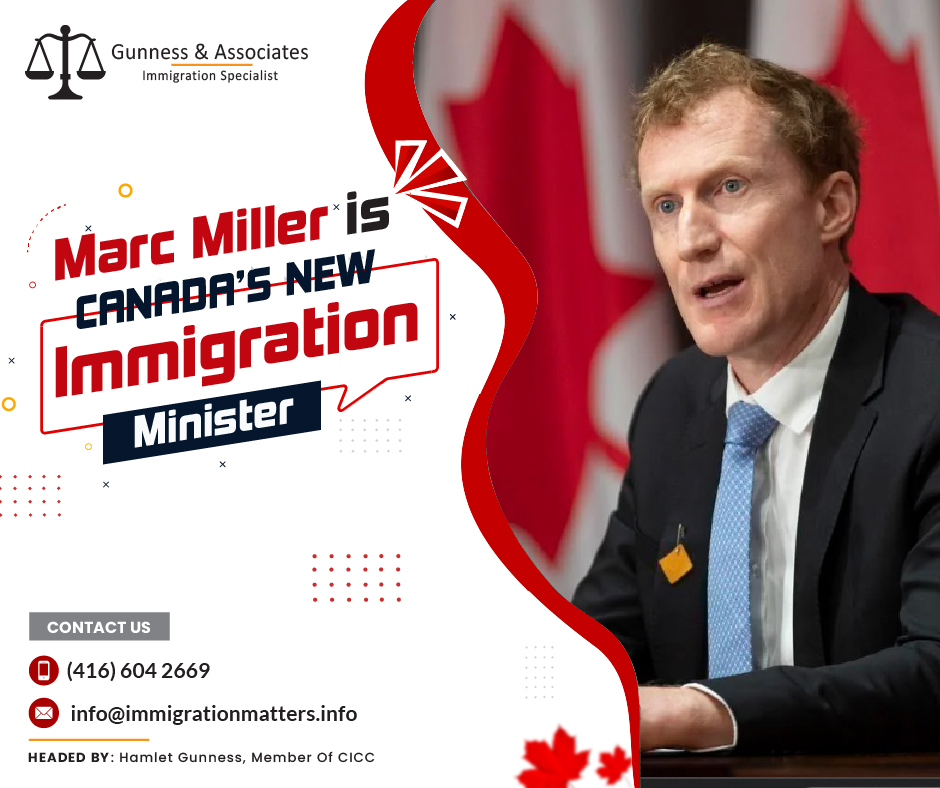
new Immigration Minister of Canada

Marc Miller is new Immigration Minister of Canada

On July 26, 2023, Canadian Prime Minister Justin Trudeau made significant changes to his cabinet. Marc Miller is now the new Immigration Minister of Canada, a Member of Parliament from Quebec, and former Minister of Crown-Indigenous Relations.  Sean Fraser, the previous Immigration Minister, is now Minister of Housing, Infrastructure, and Communities. Cabinet shuffles are common in Canadian politics, occurring every two years to replace poor-performing ministers, reward good work, and refresh policies and public communications. The last shuffle occurred in October 2021, after the federal election, when Fraser was appointed as the previous Immigration Minister and head of the Department of Immigration, Refugees, and Citizenship Canada (IRCC).   About the new Immigration Minister of Canada Prior to entering politics, Minister Miller worked as a practicing lawyer with a focus on international and commercial law and a specialty in mergers and acquisitions. According to the government’s website, he also served as an infantry soldier in the Canadian Armed Forces. A statement by Minister Miller in the House of Commons in 2017 was entirely delivered in Mohawk, an Indigenous language that had never before been used in the Canadian parliament since Confederation. Miller has pushed for more federal funding for the Canada Child Benefit, public transportation, and affordable housing.   The welcoming immigration policy of Canada Canada is considered to be welcoming to immigrants. Every year, it welcomes more than 400,000 new permanent residents. Former Immigration Minister Sean Fraser announced and put into effect a number of changes in the last few years to facilitate immigrants’ entry into Canada. It is anticipated that newly appointed Minister Miller will continue the legacy’s good work in the service of Canadians and potential immigrants. Minister Miller is well-positioned to provide a new perspective to the vital position given her remarkable history in public service and her strong commitment to promoting diversity and tolerance. Canada looks to the new minister to lead policies that hasten a quick and effective immigration process in light of the recent spike in immigration applications. Join our RSS Feed    Want to know more details about “Marc Miller is Canada’s new Immigration Minister” you can contact one of our immigration specialists at  Gunness & Associates.   Tel: (416) 604-2669  Email: info@test.immigrationmatters.info   Gunness & Associates has helped thousands of people successfully immigrate to Canada with their families. Our skilled and experienced immigration experts have the expertise to accurately examine your case and advise you on the best method of proceeding to best serve your needs.   For honest and straightforward advice, contact the experts at Gunness & Associates Get a free Assessment  Join our newsletter and get up-to-date immigration news Click here All rights reserved ©2023 Gunness & Associates

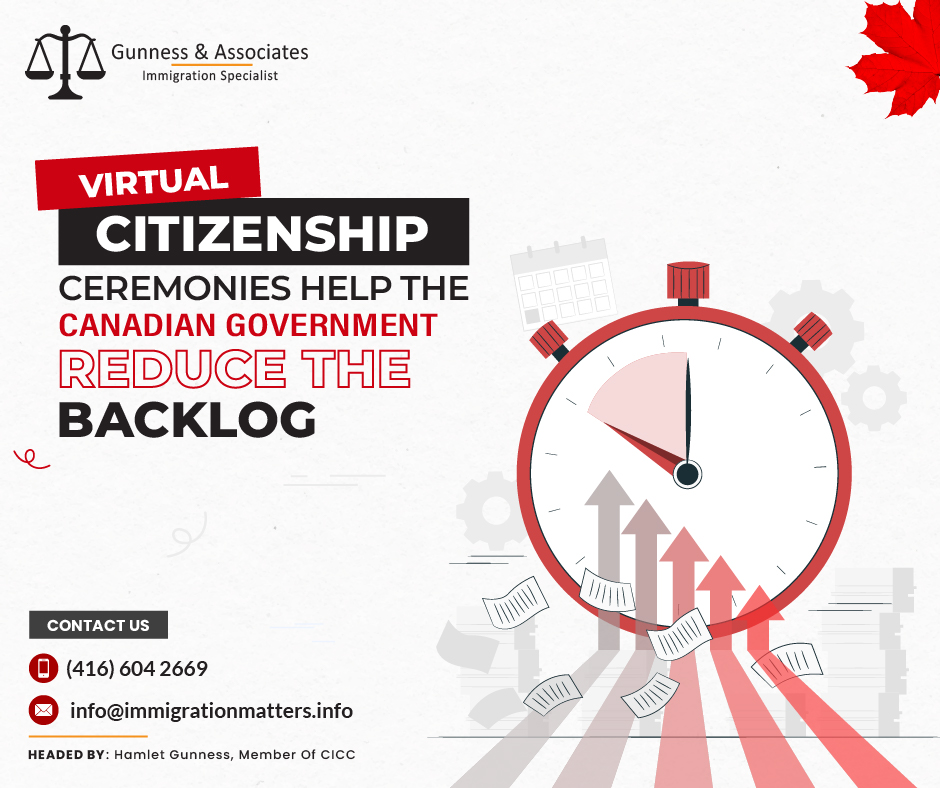
Virtual citizenship ceremonies

Virtual citizenship ceremonies help the Canadian Government reduce the backlog

The Canadian Government will soon allow new citizens to take the Virtual citizenship oath without attending a mass swearing-in ceremony. This move will reduce the backlog of citizenship applications, shorten the application processing time, and make it easier for low-income working people to become citizens.  The Government has seen a surge in citizenship applications, with more than double the number of applications received in 2022 compared to 2017. The Government is hoping to process 300,000 citizenship applications this year and has made the application process online. Of the 549,290 applicants since April 2020, over 99% have completed their oath of citizenship virtually.   About the Virtual Citizenship Ceremony Most applicants who have their applications for citizenship in Canada approved are invited to a video oath ceremony (virtual citizenship ceremony). The applicants invited to the virtual citizenship Ceremony get details in the invitation such as: the time and date of your ceremony how to reschedule your ceremony what to bring to the ceremony IRCC will make contact using the phone number or email address you provided in your application. If you need to update your contact information on your application, Use their web form to update them on any changes to your contact information. The Oath of Citizenship cannot be taken outside of Canada. If you receive your invitation when you are outside of Canada, respond to the invitation email and provide a thorough explanation of your situation. How to Become a Canadian Citizen? To become a Canadian Citizen you must be a permanent resident who has lived for at least three of the previous five years (1,095 days) in Canada, have paid their taxes, passed a citizenship test, and have shown proficiency in either English or French. Join our RSS Feed    Want to know more details about “Virtual citizenship ceremonies help the Canadian Government reduce the backlog” you can contact one of our immigration specialists at  Gunness & Associates.   Tel: (416) 604-2669  Email: info@test.immigrationmatters.info Gunness & Associates has helped thousands of people successfully immigrate to Canada with their families. Our skilled and experienced immigration experts have the expertise to accurately examine your case and advise you on the best method of proceeding to best serve your needs.   For honest and straightforward advice, contact the experts at Gunness & Associates Get a free Assessment  Join our newsletter and get up-to-date immigration news Click here All rights reserved ©2023 Gunness & Associates

processing of spousal TRVs

IRCC fastens the processing of spousal TRVs, helping more families reunite

Immigration, Refugees and Citizenship Canada (IRCC) have fastened the processing of spousal TRVs to just 30 days for applicants who have already applied for permanent residency in Canada. This means that applicants no longer need to wait in their home countries for IRCC to make a decision but can instead come to Canada and wait for the processing to be completed.  As a result, Canadians or permanent residents with spouses and dependents abroad can be reunited with their families faster and begin settling in their communities. However, it is essential to note that spouses and dependents on a TRV can only work or study in Canada once they are approved for permanent residence or obtain a work or study permit. Families must stay together, particularly through important life events like relocating to a new country. This is why Canada is trying to make it easier for families to reconnect and sustain themselves once they reach. This basically means that Canadians and permanent residents with spouses and dependents living overseas will be able to connect with them more quickly and start settling into their new homes.    Processing of spousal TRVs As an approach to helping families to spend more time together while they wait for their permanent residency to be approved, Honorable Minister Sean Fraser proposed faster processing of spousal temporary resident visas (TRVs) processing and considerate application processes.  In the future, the majority of these applications will be processed within a 30-day period, and applicants will get access to processing procedures suited to their circumstances as spouses and dependents. These new tools have already been used to process multiple applications. There has been a 93% approval rate among this set of applicants. New initiatives to support family reunions were announced by the Honourable Sean Fraser, Minister of Immigration, Refugees, and Citizenship, along with the Honourable Hedy Fry, Member of Parliament for Vancouver Centre, Including: Faster processing times for temporary residents visa (TRV) for spouses tools for processing new and specific spousal TRV applications. a new open work permit for candidates under the family and spousal classes. extensions for open work permit holders with permits expiration between August 1 and the end of 2023 Lastly, Minister Fraser declared that open work permit holders, including spousal applicants, who have open work permit expirations between August 1 and the end of 2023, will be allowed to extend their work visas for an additional 18 months.  Join our RSS Feed    Want to know more details about “IRCC fastens the processing of spousal TRVs, helping more families reunite” you can contact one of our immigration specialists at  Gunness & Associates.   Tel: (416) 604-2669  Email: info@test.immigrationmatters.info Gunness & Associates has helped thousands of people successfully immigrate to Canada with their families. Our skilled and experienced immigration experts have the expertise to accurately examine your case and advise you on the best method of proceeding to best serve your needs.   For honest and straightforward advice, contact the experts at Gunness & Associates Get a free Assessment  Join our newsletter and get up-to-date immigration news Click here All rights reserved ©2023 Gunness & Associates

economy

The Canadian Government needs more immigrants to improve the economy

The Canadian Government needs more immigrants to improve the economy as Canada faces an aging population, a new report suggests that the country needs to increase immigration to balance the demographic. According to the report, the working-age population would have to grow by 2.2% annually through 2040 to maintain the same old-age dependency ratio as in 2022. To return to the average ratio between 1990 and 2015, the same group would have to grow by 4.5% each year.  While the potential increase in immigration levels has sparked debate over whether the country can handle more newcomers, proponents argue that the labor market can absorb more workers and more working-age Canadians are needed to support the tax base. Last year, Canada’s population grew by over one million people, the fastest rate since 1957. With one million vacant jobs across the country, the country is experiencing a labor shortage, and that’s why immigration objectives are increasing. Canada has one of the oldest populations in the world, and its low birth rate leads to a labor shortage. According to Statistics Canada, the nation’s birth rate dropped to a record low of 1.4 children per woman in 2020. This would have to rise to 2.1 in order to maintain Canada’s population without immigration.   Immigrants Contributing to Canada’s Economy The economy of Canada is boosted by immigrants. According to Statistics Canada, immigrants play a significant role in all sectors of the Canadian economy. The number of people working (sometimes referred to as the labor force) and paying taxes to support public services, such as health care, is one indicator of how strong the Canadian economy is. The labor force in Canada is expanding annually due to immigration. While funding for public services is essential, embracing immigrants can aid employers in filling open positions with skilled candidates. This is a result of Canadians living longer lives and having fewer kids. Fewer people are enrolling in schools, and more individuals are retiring. As a result, there aren’t many current and future workers who were born in Canada. Not only do immigrants fill labor shortages and pay taxes, but they also spend money on goods, housing, and transportation, which helps the Canadian economy. Canada’s Immigration Levels Plan 2023-2025 According to the Canadian government’s immigration levels plan for 2023–2025, 1.45 million new permanent residents from all immigration categories are expected to arrive in Canada over the next three years. According to the government’s immigration goals, Canada will accept permanent residents through a number of programs. Canada plans to bring in 465,000, 485,000, and 500,000 additional permanent residents between 2023 and 2025. Canada welcomed 405,000 permanent residents in 2021. 431,645 people moved to Canada permanently in 2022. The following table displays Canada’s immigration plans for each immigration group between 2023 – 2025: Immigration Class 2023 2024 2025 Economic 266,210 281,135 301,250 Family 106,500 114,000 118,000 Refugee 76,305 76,115 72,750 Humanitarian 15,985 13,750 8,000 Total 465,000 485,000 500,000 Join our RSS Feed    Want to know more details about “The Canadian Government needs more immigrants to improve the economy” you can contact one of our immigration specialists at  Gunness & Associates. Tel: (416) 604-2669  Email: info@test.immigrationmatters.info   Gunness & Associates has helped thousands of people successfully immigrate to Canada with their families. Our skilled and experienced immigration experts have the expertise to accurately examine your case and advise you on the best method of proceeding to best serve your needs.   For honest and straightforward advice, contact the experts at Gunness & Associates Get a free Assessment  Join our newsletter and get up-to-date immigration news Click here All rights reserved ©2023 Gunness & Associates