Work in Canada

Employment rates for immigrants

In Canada, the highest Employment rates for immigrants who Landed from Africa and Asia

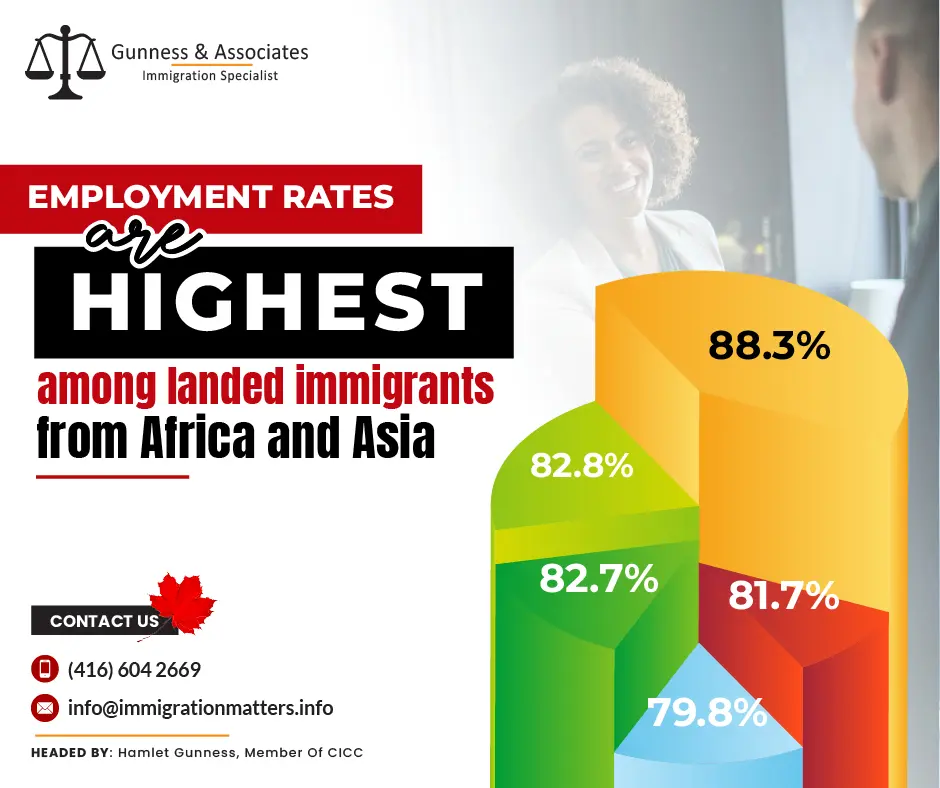
According to a Statistics Canada study, there are the highest Employment rates for immigrants who Landed from Africa and Asia than other regions. For immigrants over 15 years old in 2023, employment rates were:  Africa: 67.7%,  Asia: 66.3%,  Latin America: 66%,  North America: 56.6%, and  Europe: 56.6% (national average: 62.7%).  However, when looking at core-aged immigrants (25-54 years), the results inverted:  Europe: 88.3%,  Latin America: 82.8%,  North America: 82.7%,  Asia: 81.7%,  Africa: 79.8% (national average: 82.6%).  This suggests African and Asian immigrants are more likely to work outside the core age group, possibly due to cultural differences in schooling years. However, the study doesn’t include temporary workers and international students who comprise a significant part of Canada’s labor force, with 797,225 valid work permit holders in December 2022 and close to a million international students in 2023. The Employment rates for immigrants in Canada increased in 2023 Statistics Canada published a new study exploring links between the employment rate in Canada of core working-age immigrants and the duration of their stay in Canada. The data highlights that immigrants with over ten years of stay had the highest employment rates, while recent arrivals (within the last five years) had the lowest.  Specifically, employment rates were 77.8% for immigrants who landed five or fewer years ago, 81.9% for those who landed between 5 and 10 years ago, and 84.5% for those in Canada for over ten years. The overall employment rate for immigrants in 2023 was 82.6%, slightly lower than the 86.3% rate for Canadian-born individuals. Join our RSS Feed    If you want to know more details about “In Canada, the highest Employment rates for immigrants who Landed from Africa and Asia” you can contact one of our immigration specialists at  Gunness & Associates.   Tel: (416) 604-2669  Email: info@test.immigrationmatters.info   Gunness & Associates has helped thousands of people successfully immigrate to Canada with their families. Our skilled and experienced immigration experts have the expertise to accurately examine your case and advise you on the best method of proceeding to serve your needs.   For honest and straightforward advice, contact the experts at Gunness & Associates Get a free Assessment  Join our newsletter and get up-to-date immigration news Click here All rights reserved ©2023 Gunness & Associates

employment rate in Canada

The employment rate in Canada among immigrants increased in 2023

Statistics Canada published a new study exploring links between the employment rate in Canada of core working-age immigrants and the duration of their stay in Canada. The data highlights that immigrants with over ten years of stay had the highest employment rates, while recent arrivals (within the last five years) had the lowest.  Specifically, employment rates were 77.8% for immigrants who landed five or fewer years ago, 81.9% for those who landed between 5 and 10 years ago, and 84.5% for those in Canada for over ten years. The overall employment rate for immigrants in 2023 was 82.6%, slightly lower than the 86.3% rate for Canadian-born individuals. In December, there were more people working in professional, scientific, and technical services (+46,000; +2.4%), health care and social assistance (+16,000; +0.6%), and “other services” (including personal and repair services) (+12,000; +1.5%). Five industries experienced declines, led by wholesale and retail trade (-21,000; -0.7%) and manufacturing (-18,000; -1.0%). In December, employment increased in four provinces, led by British Columbia (+18,000; +0.6%), while it decreased in Ontario (-48,000; -0.6%). Total hours worked increased by 0.4% in December and by 1.7% year on year. IRCC sets new wage rules for employers recruiting temporary foreign workers On the other hand, in 2019 the employment rate for immigrants who arrived in Canada five years or less was 71.1%. Although this rate has also increased since dropping to 69.3% in 2020, the employment rate for this subgroup reduced slightly from 2022 (78%) to 2023 (77.8%). The employment rate in Canada for core-aged Men and Women Following two months of little change, employment among core-aged men (aged 25 to 54) increased by 25,000 (+0.4%) in December. For the third month in a row, employment among women of the same age group stayed virtually unchanged. The employment rate for the core-aged population fell from January to December, as population growth (+2.9%; +446,000) outpaced employment growth (+1.9%; +243,000). The employment rate for women in this age group fell 0.8 percentage points from a record high of 82.2% in January to 81.4% in December. The rate for men aged 25 to 54 fell 0.8 percentage points between June (88.2%) and December (87.4%) in 2023. Despite recent labor market cooling, employment rates for both core-aged women(+2.1 percentage points) and core-aged men (+0.9 percentage points) remained higher than the average observed from 2017 to 2019, before the COVID-19 pandemic. In December 2023, employment for young women aged 15 to 24 increased by 13,000 (+1.0%), while it remained virtually unchanged for young men. When compared to the other major demographic groups, youth employment fell more abruptly from January to December. Female youth rates dropped by 4.0 percentage points to 56.7%, while male youth rates dropped by 2.1 percentage points to 56.0%. Employment rates for both female (-2.4 percentage points) and male (-1.4 percentage points) youth were lower in December than they had been from 2017 to 2019. In December 2023, employment among men aged 55 and older fell by 27,000 (-1.1%), the first significant drop since February 2023. Join our RSS Feed    If you want to know more details about the “The employment rate in Canada among immigrants increased in 2023″ you can contact one of our immigration specialists at  Gunness & Associates.   Tel: (416) 604-2669  Email: info@test.immigrationmatters.info   Gunness & Associates has helped thousands of people successfully immigrate to Canada with their families. Our skilled and experienced immigration experts have the expertise to accurately examine your case and advise you on the best method of proceeding to serve your needs.   For honest and straightforward advice, contact the experts at Gunness & Associates Get a free Assessment  Join our newsletter and get up-to-date immigration news Click here All rights reserved ©2023 Gunness & Associates

Temporary Foreign Workers

IRCC sets new wage rules for employers recruiting temporary foreign workers

From January 1, 2024, employers recruiting through the Temporary Foreign Worker Program (TFWP) must adjust foreign workers’ wages to match updated prevailing rates, as per Immigration, Refugees and Citizenship Canada (IRCC). Although some employers are exempt, this usually requires a Labour Market Impact Assessment (LMIA). The Job Bank updates provincial wage differences annually.  Canada is inviting foreign workers to boost its economy amid labor shortages, with potential losses of $38 billion due to shortages, as the Canadian Federation of Independent Business (CFIB) reported. Foreign workers in Canada are legally entitled to the same rights as Canadians, with employers required to ensure a fair work environment and access to healthcare. Even if the prevailing wage falls, the updated wage can never fall below the wage identified in the positive LMIA at any time during a TFW’s employment period. Employers who fail to update wages on time may face sanctions under the TFW Program’s employer compliance regime, which includes administrative monetary penalties and program bans. Job duties and working conditions for the Temporary Foreign Workers TFWs hired through the Temporary Foreign Worker Program (TFWP) must only perform duties related to the occupation for which they were hired. All workers in Canada, including TFWs, are protected by Canadian law. Exploitation of TFWs is a violation of Canadian laws and human rights. Employers must do the following: TFWs should be paid for all work (including overtime if required by law). Insurance for workplace safety is provided. offer TFWs the same benefits as other workers, and not take the TFWs’ identification. Canada Ranks #1 as the world’s preferred work destination Most occupations are covered by provincial or territorial legislation dealing with labor and employment standards, such as: Working hours,  working conditions, and  termination of employment are all factors to consider. In fact, every province or territory has a Ministry of Labour that can provide information to help employers and TFWs with work-related questions or issues. Join our RSS Feed    If you want to know more details about the “IRCC sets new wage rules for employers recruiting temporary foreign workers” you can contact one of our immigration specialists at  Gunness & Associates.   Tel: (416) 604-2669  Email: info@test.immigrationmatters.info   Gunness & Associates has helped thousands of people successfully immigrate to Canada with their families. Our skilled and experienced immigration experts have the expertise to accurately examine your case and advise you on the best method of proceeding to serve your needs.   For honest and straightforward advice, contact the experts at Gunness & Associates Get a free Assessment  Join our newsletter and get up-to-date immigration news Click here All rights reserved ©2023 Gunness & Associates

preferred work destination

Canada Ranks #1 as the world’s preferred work destination

A recent study from the UK-based firm Givetastic has put Canada at the top of the list of most preferred work destinations worldwide. This conclusion was drawn after examining the average monthly search volume for keywords such as “jobs” and “work,” translating as needed.  The study surveyed individuals in 164 countries and highlighted Canada’s strong healthcare system, employee benefits, and thriving job market as major draws. Remarkably, Canada was the top pick for 56 countries, representing 34.1% of the world’s nations. This underscores Canada’s standing as a leading global employment center. The study found that several nations, including Bangladesh, Nigeria, the Philippines, Singapore, South Korea, the US, Chile, Kenya, and Ecuador, ranked Canada as their top destination for employment.  For many reasons, Canada is a popular place for foreign nationals to work and immigrate. The country’s main advantages are its excellent standard of living, universal healthcare, and top-notch educational system.    In addition to being a peaceful country with a low crime rate, Canada is safe and welcoming to immigrants and their families.   Canada is one of the most diverse countries in the world and is ranked as the dreamwork destination. It encourages tolerance and acceptance of all cultures and religions, which makes it simpler for immigrants to settle down, assimilate into Canadian society, and get involved in their new communities. The country also offers a variety of work/study permit programs, sponsorship opportunities, and immigration streams in an effort to promote a diverse workforce and guarantee socioeconomic growth.  According to Givetastic’s research, the world’s preferred work destinations are: According to Givetastic’s research, the top dream job destinations were: Canada (top choice in 56 countries) Germany (13 countries) Qatar (11 countries) U.K. (8 countries) Switzerland, Australia (7 countries each) Spain, U.S. (6 countries each) Malta (5 countries) Niger, Portugal (4 countries each). What are the Canada Immigration Programs for Professionals and Skilled Workers? There are several Canadian immigration programs for professionals and skilled workers, a few of those are: Express Entry, Immigrate as a skilled worker. Family sponsorship.  Provincial Nominee Programs.  Atlantic Immigration Program.  Caregivers.  Start-up Visa (SUV). Self-employed Rural and Northern Immigration Pilot Agri-Food Pilot Temporary resident to permanent resident pathway Economic Mobility Pathways Pilot Join our RSS Feed    If you want to know more details about the “Canada holds the top spot as the world’s preferred work destination” you can contact one of our immigration specialists at  Gunness & Associates.   Tel: (416) 604-2669  Email: info@test.immigrationmatters.info   Gunness & Associates has helped thousands of people successfully immigrate to Canada with their families. Our skilled and experienced immigration experts have the expertise to accurately examine your case and advise you on the best method of proceeding to serve your needs.   For honest and straightforward advice, contact the experts at Gunness & Associates Get a free Assessment  Join our newsletter and get up-to-date immigration news Click here All rights reserved ©2023 Gunness & Associates

Canadian Immigration in 2024

Insights into Canadian Immigration in 2024

The Express Entry System,  Provincial Nominee Programs (PNPs), International Student Programs, Parents and Grandparents Program, and IRCC plans to leverage AI are a few of the insights into Canadian Immigration in 2024. Immigration, Refugees and Citizenship Canada (IRCC) plans to welcome 485,000 permanent residents in 2024. The Express Entry System will continue holding category-based draws, focusing on specific labor gaps. In the first year of category-based draws, the IRCC identified to give priority to the immigration candidates included: proficient in French recent work experience in any of the primary sectors, including trades, agri-food/agriculture, healthcare, STEM, and transportation In addition, this year, Provincial Nominee Programs (PNPs), Canada’s largest immigration pathway, will introduce new guidelines and multi-year plans. The provinces and territories will have advance notice of the 2025 allotment as the IRCC releases new multi-year plans for PNPs, which will enable them to better plan their immigration strategies. Furthermore, the International Student Program will improve its Letter of Acceptance verification system and review the Post-Graduation Work Permit program. International students in Canada hope for a PGWP extension in 2024, given the limited options for permanent residency. By mid-2023, Canada had approximately 2.2 million temporary residents, with over 1 million holding work permits – which has almost doubled in a year.  The Parents and Grandparents Program (PGP) will be increased to 32,000 in 2024 according to the new Immigration Levels Plan. The intention is to increase intake so that more PGP candidates can come to Canada. Lastly, IRCC plans to leverage AI to streamline the immigration process, and a new advisory board will focus on immigration policy. The following are some ways that the digital revolution will enhance the candidate customer experience: improving the standard for services improved partnerships with organizations and employers increasing the accessibility of applications by using virtual and digital technologies Join our RSS Feed    If you want to know more details about the “Insights into Canadian Immigration in 2024″ you can contact one of our immigration specialists at  Gunness & Associates.   Tel: (416) 604-2669  Email: info@test.immigrationmatters.info   Gunness & Associates has helped thousands of people successfully immigrate to Canada with their families. Our skilled and experienced immigration experts have the expertise to accurately examine your case and advise you on the best method of proceeding to serve your needs.   For honest and straightforward advice, contact the experts at Gunness & Associates Get a free Assessment  Join our newsletter and get up-to-date immigration news Click here All rights reserved ©2023 Gunness & Associates

population growth since 1957

Immigration drives Canada’s largest population growth since 1957

As of October 1, 2023, Canada’s population reached an estimated 40.5 million, marking a 1.1% increase since July 1, 2023 – the highest quarterly population growth since 1957. Canada added over a million people for the first nine months of 2023, breaking 2022’s record.  96% of the growth in the third quarter of 2023 was due to international migration, and the rest was from natural increase. Canada welcomed nearly 108,000 immigrants in the third quarter of 2023 and reached 80% of its annual immigration target by September. All provinces and territories except the Northwest Territories saw population growth, with Alberta, Prince Edward Island, and Ontario surpassing the national average. Except for Alberta, which continued to have the highest net gains (+17,094), and New Brunswick (+21), all provinces and territories recorded losses in interprovincial migration exchanges in the third quarter of 2023. For the first time since comparable data were made available (1971), Alberta has recorded interprovincial migration gains of 10,000 or more for five consecutive quarters. Alberta gained the majority of its population through interprovincial migration as a result of exchanges with Ontario and British Columbia. In contrast, for the first time since the first quarter of 2013, British Columbia experienced five consecutive quarters of interprovincial migration losses. In the third quarter, Canada welcomed 107,972 immigrants. From January to September 2023, immigration reached 79.8% (371,299) of the year’s target of 465,000 immigrants set by Immigration, Refugees, and Citizenship Canada. From July 1 to October 1, the country saw an increase in the number of non-permanent residents, with the total non-permanent resident population rising from 2,198,679 to 2,511,437. This represents a net increase of 312,758 non-permanent residents in the third quarter, the largest quarterly increase since 1971. The increase in non-permanent residents was primarily due to an increase in the number of work and study permit holders, and to a lesser extent, an increase in refugee claimants. Join our RSS Feed    If you want to know more details about “Immigration drives Canada’s largest population growth since 1957″ you can contact one of our immigration specialists at  Gunness & Associates.   Tel: (416) 604-2669  Email: info@test.immigrationmatters.info Gunness & Associates has helped thousands of people successfully immigrate to Canada with their families. Our skilled and experienced immigration experts have the expertise to accurately examine your case and advise you on the best method of proceeding to serve your needs.   For honest and straightforward advice, contact the experts at Gunness & Associates Get a free Assessment  Join our newsletter and get up-to-date immigration news Click here All rights reserved ©2023 Gunness & Associates

LMIA applications

ESDC updated processing times for LMIA applications

On December 14, 2023, Employment and Social Development Canada (ESDC) updated the processing times for the LMIA applications under various streams. Based on statistics from all processing centers, the current average LMIA processing times have decreased only for the Global Talent Stream.  Global Talent Stream – 6 business days (-3 days) Agricultural stream – 12 business days (+1 day) Seasonal Agricultural Worker Program – 8 business days Permanent residence Stream – 77 business days (+20 days) In-home caregivers – 23 business days (+3 days) High-wage Stream – 44 business days Low-wage Stream – 49 business days Service Canada is committed to providing a positive client experience to all Temporary Foreign Worker Program (TFWP) applicants and recognizes that the program, through its various delivery streams, is critical to addressing labor shortages in Canada and meeting the needs of Canadian businesses. LMIA application processing times can vary depending on the number of applications received by the TFWP.  About Global Talent Stream The Global Talent Stream provides timely, responsive, and predictable client-focused service to assist you in gaining access to highly skilled global talent in order to expand your workforce in Canada and remain competitive on a global scale. This stream is intended for innovative Canadian firms that have been referred to Service Canada by a designated referral partner and require unique and specialized foreign nationals to scale up and grow. It’s also intended for Canadian businesses looking to fill a high-demand, highly-skilled position on the Global Talent Occupations List. Join our RSS Feed    If you want to know more details about the “ESDC updated processing times for LMIA applications in December” you can contact one of our immigration specialists at  Gunness & Associates.   Tel: (416) 604-2669  Email: info@test.immigrationmatters.info   Gunness & Associates has helped thousands of people successfully immigrate to Canada with their families. Our skilled and experienced immigration experts have the expertise to accurately examine your case and advise you on the best method of proceeding to serve your needs.   For honest and straightforward advice, contact the experts at Gunness & Associates Get a free Assessment  Join our newsletter and get up-to-date immigration news Click here All rights reserved ©2023 Gunness & Associates

migrating to Canada

US workers showing a growing interest in migrating to Canada

Many US workers are considering migrating to Canada due to its welcoming immigration measures, which aim to address labor shortages. In July, Canada launched a pilot program allowing 10,000 H-1B visa holders to apply for a three-year open work permit.  The program reached its cap within 48 hours, and 6,000 US foreign workers have migrated since then. The move can be attributed to restrictions faced by H-1B holders and their families in the US.  Many skilled workers, particularly in tech, were laid off during the “US Tech Wreck,” leading them to seek opportunities in Canada. Canada’s former Immigration Minister Sean Fraser saw this as an opportunity to fill Canada’s STEM shortage, leading to the launch of the Tech Talent Strategy at Collision 2023. About the Open Work Permit A work permit is a legally recognized document that enables a foreign national to work in Canada. A work permit that has no limits to a specific employer or location is referred to as an open work permit. It means that a foreign national may work for several employers in various locations across Canada as long as they have a valid open work permit. It should be noted that foreign nationals may be subject to additional requirements or restrictions with certain open work permits. Usually, open work permits get issued under the following immigration programs: Post-Graduation Work Permits (PGWP) International Experience Canada (IEC) Inland Spousal or Common-Law Sponsorship Bridging Open Work Permits (BOWP) If you’re an H-1B visa holder and planning to immigrate to Canada, Get legal assistance. Canada’s Tech Talent Strategy The Honourable Sean Fraser, Minister of Immigration, Refugees, and Citizenship, launched Canada’s first-ever Tech Talent Strategy on June 27, 2023 at Collision 2023. This new strategy includes new measures as well as improvements to existing measures to help Canadian businesses thrive in an environment of competition. Minister Fraser announced the following aggressive attraction measures as part of Canada’s first-ever Tech Talent Strategy: the establishment of an open work permit stream in which H-1B specialty occupation visa holders in the United States can apply for a Canadian work permit, as well as study or work permit options for their accompanying family members. the creation of an Innovation Stream within the International Mobility Program to attract highly skilled workers, with options including employer-specific work permits for up to five years for workers destined to work for a company identified by the Government of Canada as contributing to Canada’s industrial innovation goals, and open work permits for up to five years for highly skilled workers in select in-demand occupations. a return to the Global Skills Strategy’s 14-day service standard for work permits. The promotion of Canada as a digital nomad destination. the establishment of a STEM-specific draw under category-based selection to issue additional invitations to apply under the Express Entry program, and improvements to the Start-up Visa Program. Join our RSS Feed    If you want to know more details about “US workers showing a growing interest in migrating to Canada” you can contact one of our immigration specialists at  Gunness & Associates.   Tel: (416) 604-2669  Email: info@test.immigrationmatters.info   Gunness & Associates has helped thousands of people successfully immigrate to Canada with their families. Our skilled and experienced immigration experts have the expertise to accurately examine your case and advise you on the best method of proceeding to serve your needs.   For honest and straightforward advice, contact the experts at Gunness & Associates Get a free Assessment  Join our newsletter and get up-to-date immigration news Click here All rights reserved ©2023 Gunness & Associates
internationally-educated nurses

Manitoba is working to ease barriers for internationally-educated nurses

Manitoba’s Immigration Minister Malaya Marcelino is working to ease accreditation for internationally-educated nurses in the province. Marcelino, who took over the immigration portfolio a month ago, is responding to calls from these nurses across Canada.  The Manitoba government successfully welcomed hundreds of foreign healthcare professionals after a Philippines mission, with over 300 now working as nurses or health aides across the province.  Manitoba Health Minister Audrey Gordon reiterated their commitment to health system improvement and patient care access. Over 300 candidates who passed interviews during a recruitment mission to the Philippines accepted job offers and have started arriving in Manitoba. Monika Warren, Shared Health’s chief nursing officer, expressed confidence that the new hires will be able to overcome any immigration and licensing issues.  “We chose candidates we thought would be successful.” “There were some candidates who were screened out, and some who we didn’t even interview because we felt they had too big a hill to climb, as it were,” she said at a news conference on Tuesday. According to Warren, health officials noticed that half of the new hires have family connections in Manitoba, so the province attempted to place them in communities where they had friends and/or family.  She also stated that they will be assigned mentors at work and will be assisted in finding accommodations.  Canada is attracting more internationally educated healthcare professionals Newfoundland and Labrador, Nova Scotia, and Saskatchewan had the highest percentage of internationally educated healthcare professionals (IEHPs) working in their fields in 2021, with 74%, 68%, and 67%, respectively.  Ontario had attracted the most significant number of IEHPs, with 116,310 residing there in 2021. IEHPs were most likely to be nurses, with one-third studying nursing.  The fields of study varied by province, with: Prince Edward Island has the highest percentage of IEHPs studying nursing at 53%,  Newfoundland and Labrador has 30% trained to be physicians, and  Ontario has the highest proportion of IEHPs studying dentistry at 10% or pharmacy at 9%. Join our RSS Feed    If you want to know more details about “Manitoba is working to ease barriers for internationally-educated nurses” you can contact one of our immigration specialists at  Gunness & Associates.   Tel: (416) 604-2669  Email: info@test.immigrationmatters.info Gunness & Associates has helped thousands of people successfully immigrate to Canada with their families. Our skilled and experienced immigration experts have the expertise to accurately examine your case and advise you on the best method of proceeding to serve your needs.   For honest and straightforward advice, contact the experts at Gunness & Associates Get a free Assessment  Join our newsletter and get up-to-date immigration news Click here All rights reserved ©2023 Gunness & Associates

temporary policies

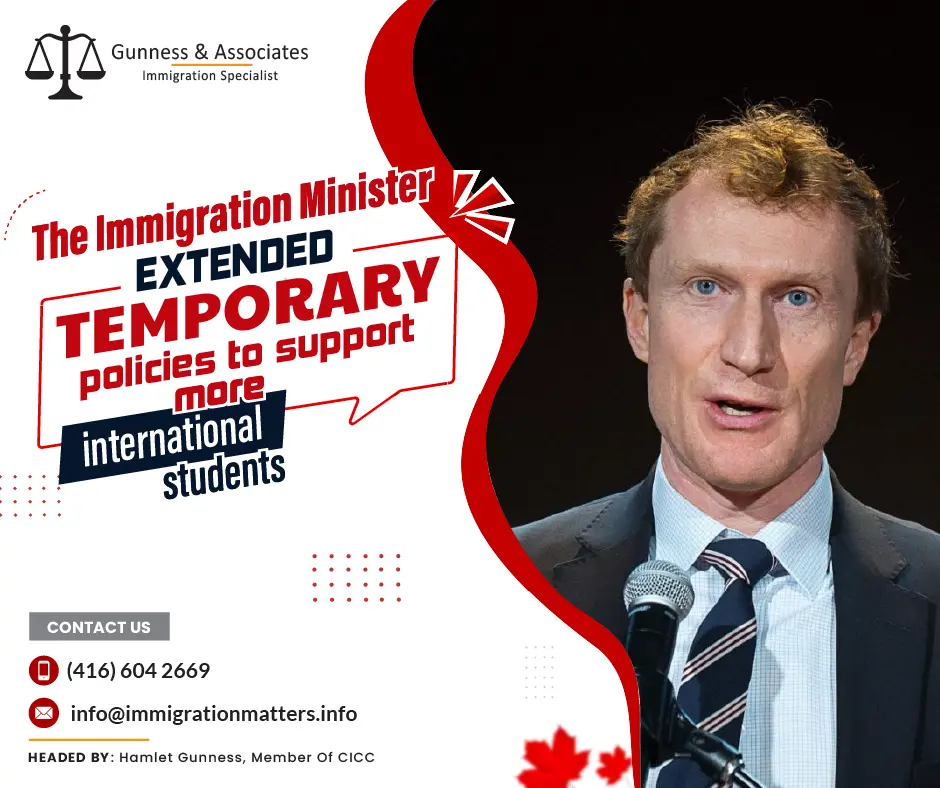
The Immigration Minister extended temporary policies to support more international students

Marc Miller, the Minister of Immigration, Refugees and Citizenship Canada (IRCC), announced the extension of three temporary policies set to expire in 2023. IRCC extended the waiver, allowing students to work off-campus for more than 20 hours weekly until April 30, 2024. This applies to students already in Canada and those who apply for a study permit by December 7, 2023.  Furthermore, the measure allowing online study time to count towards a post-graduation work permit will continue for students starting before September 1, 2024.  In addition, the Canadian Government extended the temporary policy granting an extra 18-month work permit for post-graduation work permit holders with expiring work permits.  Post-graduation work permit holders whose initial permit expires by December 31, 2023, can apply to extend their work permit. Extended temporary policies to support more international students Minister Miller also provided an update on three temporary policies affecting international students, all set to expire at the end of 2023. The exemption from work limit The exemption from the 20-hour-per-week limit on the number of hours international students may work off campus while classes are in session will be extended until April 30, 2024. International students who are already in Canada and applicants who have already applied for a study permit as of December 7, 2023, will be able to work more than 20 hours per week off campus until that date. We will continue to look into future options for this policy, such as increasing off-campus work hours for international students to 30 hours per week while classes are in session. International students to count time spent For students who begin a study program before September 1, 2024, the facilitative measure that allows international students to count time spent studying online towards the length of a future post-graduation work permit, as long as it constitutes less than 50% of the program of study, will remain in place. Students who begin a study program on or after that date will no longer be subject to this measure. Distance learning facilitation measures were first implemented in response to travel restrictions during the pandemic in 2020, and their scope was reduced in September 2022. The vast majority of international students are currently studying in person in Canada. Post-graduation work permit apply In response to labor market disruptions during the pandemic and post-pandemic recovery, a temporary policy was implemented three times to provide post-graduation work permit holders with an additional 18-month work permit as their initial work permit expired. Foreign nationals with a post-graduation work permit that expires before December 31, 2023, can still apply. This temporary policy, however, will not be extended further. Join our RSS Feed    If you want to know more details about “The Immigration Minister extended temporary policies to support more international students” you can contact one of our immigration specialists at  Gunness & Associates.   Tel: (416) 604-2669  Email: info@test.immigrationmatters.info   Gunness & Associates has helped thousands of people successfully immigrate to Canada with their families. Our skilled and experienced immigration experts have the expertise to accurately examine your case and advise you on the best method of proceeding to serve your needs.   For honest and straightforward advice, contact the experts at Gunness & Associates Get a free Assessment  Join our newsletter and get up-to-date immigration news Click here All rights reserved ©2023 Gunness & Associates